埄
Character Story & Explanation
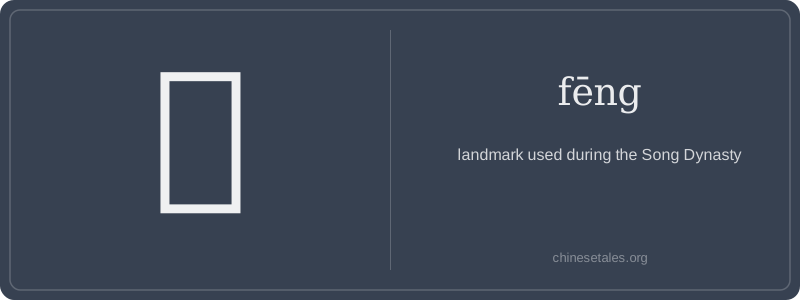
The earliest form of 埄 appears in Song-era stele inscriptions, not oracle bones (it’s too late for that). Visually, it’s a deliberate fusion: the left side is 土 (tǔ, 'earth'), drawn with three horizontal strokes and a downward hook — representing cultivated ground. The right side is 冫 (bīng, 'ice'), but here it’s not about cold; it’s a stylized variant of 凡 (fán), which itself evolved from a pictograph of a vessel base — symbolizing 'foundation' or 'base point'. Over centuries, the right component simplified into two falling strokes (冫), making the character look deceptively like 'frozen earth', though it has zero connection to temperature.
This visual evolution mirrors its semantic journey: from concrete earthwork (a mound of soil piled at a precise location) to abstract administrative unit (the zone defined *by* that mound). The Song legal code《宋刑统》mentions 埄 repeatedly in land dispute clauses — e.g., 'if one moves the 埄 without permission, penalty applies'. Its shape literally grounds authority in geography: the 土 says 'this is earth', the 冫 says 'this is fixed, non-negotiable, baseline'. No classical poetry uses it — it’s strictly documentary, the kind of word scribes carved with chisels, not poets whispered in gardens.
At first glance, 埄 (fēng) feels like a linguistic fossil — it’s not used in modern spoken or written Chinese at all. It’s a Song Dynasty relic, specifically a technical term for a type of official boundary marker: earthen mounds or stone piles erected to demarcate fields, tax districts, or administrative zones. To native speakers today, it’s virtually invisible — you won’t hear it in conversation, see it on signs, or find it in newspapers. Its ‘meaning’ isn’t conceptual but archival: it evokes bureaucracy, land surveys, and the meticulous statecraft of imperial China. Think of it less as a word and more as a bureaucratic glyph — like finding the word 'perch' in an English legal document about medieval land measurement.
Grammatically, 埄 functions only as a noun, always embedded in compound terms like 埄界 (fēng jiè, 'boundary marker') or 埄土 (fēng tǔ, 'marked land'). You’ll never use it alone — no 'this is a 埄' sentences. It doesn’t take modifiers, particles, or aspect markers. Learners sometimes try to force it into modern grammar ('wǒ kàn dào yī gè fēng'), but that sounds deeply anachronistic — like saying 'I saw a yeoman' in casual American English. Its syntax is frozen in time: it appears only after verbs like 立 (lì, 'to erect') or 刻 (kè, 'to inscribe') in historical texts.
Culturally, 埄 reveals how deeply the Chinese state tied land, identity, and taxation together. Every 埄 was a physical assertion of imperial order — earth shaped by human will to make chaos legible. Modern learners often misread its radical 土 as suggesting 'soil' or 'dirt' in a generic sense, missing its precise administrative weight. Worse, they confuse it with common characters like 封 (fēng, 'to seal') — but while 封 implies closure or appointment, 埄 implies placement, visibility, and jurisdiction. It’s not about sealing something *in*, but marking something *out*.