埃
Character Story & Explanation
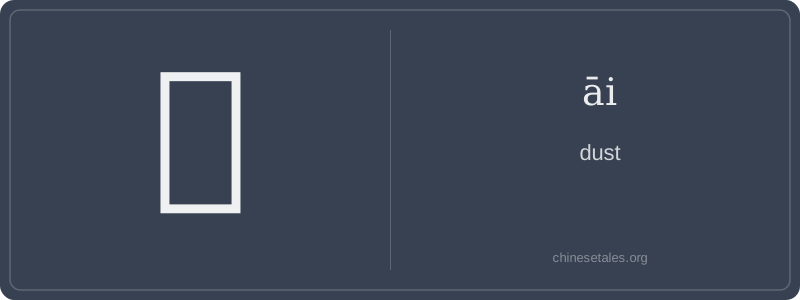
The earliest form of 埃 appears in bronze inscriptions as a combination of 土 (tǔ, 'earth') and 一 (yī, horizontal line representing surface or layer) — sometimes with a dot or short stroke above, symbolizing particles suspended just above ground. Over centuries, the top evolved into 亠 (a 'lid' radical suggesting coverage), then further stylized into the current top component resembling 'lì' (but not the character 立). The lower part solidified as 土, anchoring the meaning firmly in earth and soil. By the Small Seal Script era, the ten strokes were standardized: two dots (representing airborne specks), a lid-like cover, and the stable earth base — visually echoing how dust hovers *just above*, never quite separate from, the ground.
This visual logic shaped its semantic journey: from concrete 'fine earth particles' in early texts like the *Shuōwén Jiězì* (100 CE), where it’s defined as 'microscopic earth', to metaphorical uses by the Tang dynasty — Li Bai wrote of ‘stars dimmed by sky-āi’, using it to evoke celestial haze. Its rarity in daily speech isn’t neglect; it’s reverence. Like choosing 'vermillion' over 'red' in English, 埃 is selected when precision and poetic gravity matter — a lexical fossil that still breathes in scientific journals and classical allusions alike.
Think of 埃 (āi) as Chinese 'dust' — not the fluffy kind you wipe off a bookshelf, but the ancient, poetic, almost cosmic dust: the fine grit that settles on forgotten temples, clings to moonlit pavilions, or swirls in the silent aftermath of dynasties falling. It’s less 'household dust' and more 'the dust of time' — evoking fragility, transience, and quiet erosion. Unlike the neutral, everyday 尘 (chén), which appears in HSK vocabulary like 尘土 (dust and soil), 埃 feels literary, slightly archaic, and often appears in fixed expressions or compound nouns rather than standalone verbs.
Grammatically, 埃 rarely stands alone in speech — you won’t hear someone say *'This table is full of āi!'* Instead, it functions almost exclusively within compounds: 沙埃 (shā’āi, sand-dust), 灰埃 (huī’āi, ash-dust), or metaphorically in phrases like 蒙尘 (méng chén) — wait, note the chén! That’s the point: learners often mistakenly swap 埃 for 尘 here, but 尘 is the go-to character for 'dust' in active, descriptive contexts; 埃 is reserved for weightier, denser, or more granular connotations — especially when paired with words implying dryness, decay, or invisibility.
Culturally, 埃 carries a whisper of classical restraint. It appears in Tang poetry describing abandoned battlefields ('wind stirs the yellow sand and āi') and modern scientific writing for 'micron-scale particulates'. A common mistake? Assuming it’s interchangeable with 尘 or 污 (wū, 'dirt'). But 埃 implies fineness and stillness — not grime, not stain, but the silent, cumulative residue of time itself. Use it like a brushstroke in ink painting: sparingly, deliberately, and only when the mood calls for solemnity.