埂
Character Story & Explanation
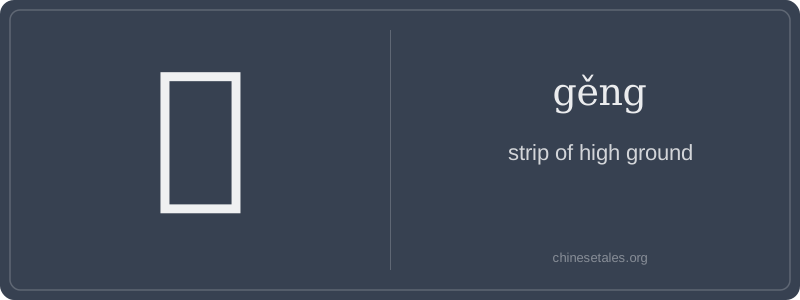
The earliest form of 埂 appears in Han dynasty clerical script, not oracle bone — because it’s a latecomer, born from practical farming needs. Visually, it’s a masterclass in semantic efficiency: left side 土 (tǔ, 'earth') anchors the meaning in soil; right side 更 (gēng, originally picturing a night watchman changing shifts, later meaning 'to change' or 'to alternate') was borrowed here *purely for sound*. So 埂 is a phono-semantic compound: 土 hints at earth, 更 tells you how to say it (gěng). Stroke-by-stroke, it flows — first the three horizontal strokes of 土, then the complex nine-stroke 更, simplified over centuries into today’s clean 10-stroke form.
Its meaning stayed remarkably stable: from Han agricultural records describing ‘raised ridges separating flooded fields’ to modern dialect speech in the Yangtze Delta. Interestingly, 更 didn’t contribute meaning — no ‘change’ or ‘alternation’ is implied in 埂. This is classic ‘phonetic borrowing’: the sound mattered, not the sense. Classical poets rarely used it alone, but it appears embedded in compound terms like 田埂 (tián gěng, 'field ridge') in Ming dynasty farming almanacs — always tied to labor, water, and quiet territorial boundaries between families’ plots.
Picture a narrow ridge of earth rising between rice paddies in southern China — not a mountain, not a hill, but something quieter and more functional: a raised earthen path or embankment used for walking, drainage, or dividing fields. That’s 埂 (gěng): a humble yet precise word for a ‘strip of high ground’. It’s deeply agrarian in feel — you won’t hear it in city subway announcements, but you’ll see it scrawled on village land surveys or heard in farmers’ conversations about irrigation. Unlike generic words like 山 (shān, 'mountain') or 坡 (pō, 'slope'), 埂 implies human intention: it’s *built*, not just formed by nature.
Grammatically, 埂 is a noun that almost always appears with classifiers like 条 (tiáo, for long, thin objects) or 道 (dào, for paths/ridges), e.g., 一条埂 (yī tiáo gěng). It rarely takes verbs directly — you don’t ‘埂’ something; you *walk along*, *build*, or *clear* a 埂. Learners sometimes misread it as 哽 (gěng, 'to choke') due to identical pinyin and tone — a hilarious but dangerous slip! Also, while 土 (tǔ, 'earth') is its radical, don’t assume it means ‘soil’; the meaning lives entirely in the *shape and function* of the landform.
Culturally, 埂 reflects China’s millennia-old wet-rice civilization — where every centimeter of elevation mattered for water control. In classical texts, it appears in agricultural manuals like the *Qimin Yaoshu* (c. 535 CE), describing field management. Modern usage is regional (most common in Jiangsu, Zhejiang, Sichuan), and younger urban speakers may replace it with more generic terms like 路 (lù, 'road') or 坡 (pō). Still, if you’re mapping farmland, negotiating land rights, or reading rural poetry, 埂 is irreplaceable — a tiny character holding up the whole hydrological logic of traditional Chinese agriculture.