垾
Character Story & Explanation
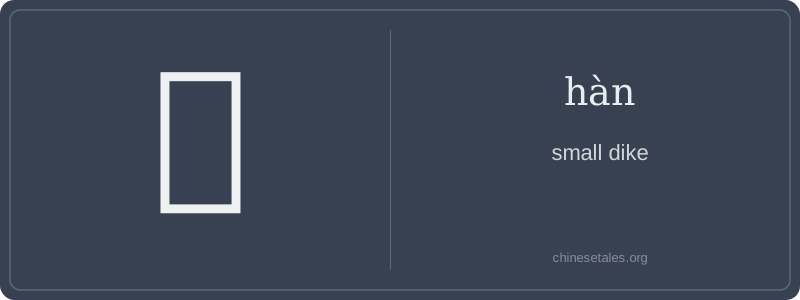
The earliest form of 垾 appears in Han-dynasty seal script, where it clearly shows its dual nature: the left radical 土 (tǔ, 'earth') anchors it in the material world, while the right component 干 (gān, originally meaning 'to dry' or 'barrier') evolved from a pictograph of crossed stakes driven into soil — visual shorthand for a man-made ridge holding back water. Over time, the 干 component simplified and stylized, losing its stake-like clarity but retaining angular firmness, while the 土 radical stayed grounded (literally), often written with a slight hook on the final stroke to suggest compacted earth.
By the Tang dynasty, 垾 had narrowed from general 'earthen barrier' to specifically 'low, narrow dike between fields' — especially in southern paddy agriculture. It appears in Song-era land records describing irrigation networks in Jiangnan, always paired with terms like 埂 (gěng, 'ridge') or 堤 (dī, 'larger dike'), signaling its modest scale. Its visual balance — earth + dry/barrier — perfectly mirrors its function: not to stop floods, but to gently guide moisture where rice needs it. No classical poetry celebrates it; its poetry is in silent, soaked soil.
At first glance, 垾 (hàn) feels like a quiet, almost forgotten character — it means 'small dike' or 'low earthen embankment', something humble and functional, built not for grandeur but for quiet control of water. In Chinese agrarian thought, this isn’t just infrastructure; it’s wisdom in miniature: the idea that resilience comes not from towering walls, but from precisely calibrated, low-profile barriers that work *with* nature’s flow — a deeply Daoist sensibility embedded in a single character.
Grammatically, 垾 is almost exclusively a noun, rarely used alone in modern speech. You’ll encounter it mainly in compound words (like 堤垳 or 垾埂), technical agricultural texts, or local dialect descriptions of field boundaries — never as a verb or adjective. Learners sometimes misread it as a variant of 汉 (hàn, 'Han') due to identical pronunciation, but there’s zero semantic overlap: one is water management, the other is an ethnic group or dynasty. It also never appears in daily conversation or HSK vocabulary — think of it as a ‘fieldnote character’, preserved in soil surveys, not subway announcements.
Culturally, 垾 reveals how Chinese writing encodes ecological memory: every stroke reflects centuries of intimate negotiation with floodplains and rice paddies. Mistake it for 汗 (hàn, 'sweat')? That’s a classic slip — same sound, wildly different worlds (earth vs. body). Native speakers rarely use it outside specialist contexts, so learners shouldn’t stress memorizing it broadly — but spotting it in a regional farming manual? That’s a quiet badge of linguistic depth.