垺
Character Story & Explanation
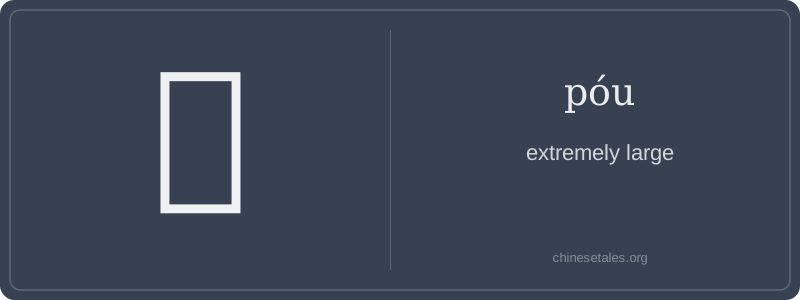
The earliest form of 垺 appears in Warring States bamboo slips as a compound ideograph: top part resembles ‘mountain’ (山), bottom part stylized as ‘earth’ (土) with three horizontal strokes suggesting deep, layered strata — together depicting ‘a mountain rising from foundational, infinite earth’. Over centuries, the mountain component simplified into the radical 厂 (hǎn, ‘cliff’), while the lower part evolved into 匋 (táo, ‘pottery vessel’), not for ceramics, but because its rounded, capacious shape visually echoed ‘containing boundlessness’. By the Han dynasty, the character stabilized as 垺 — a cliff (厂) sheltering an overflowing vessel (匋), symbolizing containment so vast it defies containment.
This visual paradox — a boundary (cliff) holding the uncontainable (vessel overflowing with cosmic scale) — directly shaped its meaning. In the Zhuangzi, Chapter 17 uses 垺然 to describe the sage’s mind: ‘not merely broad, but 垺然 — spacious as the void before creation’. Later Tang poets like Li Bai deployed 垺然大物 to mock imperial pretensions — a ‘cosmically immense thing’ that was, in truth, hollow. The character thus embodies a quintessentially Daoist irony: true vastness cannot be measured, only gestured toward through paradoxical imagery.
Imagine you’re reading an ancient Daoist text where a sage describes the primordial chaos before heaven and earth formed — not just vast, but *unfathomably* immense, beyond measurement or imagination. That’s the vibe of 垺 (póu): it doesn’t mean ‘big’ like dà (大) or even ‘huge’ like jùdà (巨大); it’s poetic, archaic, and emphatically *extreme* — think ‘cosmically colossal’, ‘primordially boundless’. It’s not used in daily speech or modern news; you’ll only meet it in classical poetry, philosophical treatises, or rhetorical flourishes meant to evoke awe.
Grammatically, 垺 functions almost exclusively as an adjective modifying nouns — and crucially, it *always* appears in fixed literary collocations like 垺然 (póu rán), never alone. You’d never say ‘this mountain is 垺’ — that would sound nonsensical and ungrammatical. Instead, it appears in set phrases: 垺然大物 (póu rán dà wù, ‘a cosmically immense thing’), often ironically for something absurdly oversized, or 垺然自得 (póu rán zì dé, ‘serenely self-possessed on a cosmic scale’). Learners often misread it as a synonym for ‘very large’ and try to use it predicatively — a classic fossil-word trap.
Culturally, 垺 carries Daoist and Zhuangzian resonance: it evokes the ineffable vastness of the Dao itself. Mistake it for common adjectives like pàng (胖, ‘fat’) or páng (庞, ‘massive’) and you’ll lose the philosophical gravity — and likely confuse your listener entirely. It’s not about size in meters; it’s about ontological scale. Think of it as Chinese linguistic dark matter: invisible in everyday usage, but essential to the universe of classical expression.