垮
Character Story & Explanation
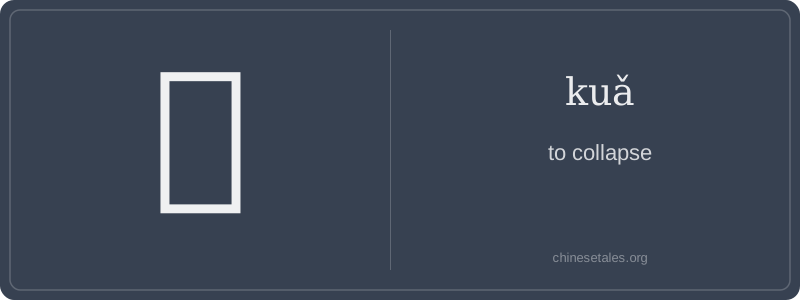
The earliest form of 垮 appears in Han dynasty clerical script, not oracle bones — it’s a relatively late-comer. Its left side 土 (tǔ, 'earth/soil') anchors it as a ground-related event, while the right side is a stylized variant of 跨 (kuà, 'to stride over'), which itself evolved from a pictograph of a person stepping across something. Over centuries, the 'person' in 跨 shrank and fused into the angular, downward-slanting strokes we see today — three sharp, descending lines (丿 丿 ㇏) that visually scream 'giving way', 'sinking', 'caving in'.
This visual logic directly shaped its meaning: originally describing earthen structures failing — levees, adobe walls, kilns — 垮 entered classical texts only sparingly, but by the Ming-Qing vernacular novels, it was vividly deployed for moral and physical collapse alike. In The Scholars, a corrupt official’s reputation is said to 垮得比窑砖还快 — linking material decay with ethical disintegration. The character’s very shape — earth + collapsing motion — makes it an embodied metaphor: collapse isn’t abstract; it’s soil sliding, foundations yielding, gravity winning.
Think of 垮 (kuǎ) as Chinese’s version of the 'domino effect' — not just falling, but a sudden, irreversible structural failure: a dam bursting, a stock market imploding, or your carefully built sandcastle dissolving at high tide. Unlike generic 'fall' verbs like diē (跌) or dǎo (倒), 垮 carries visceral weight — it implies systemic collapse, often with emotional or moral gravity. It’s rarely used for people tripping; you don’t 垮 down stairs — you 垮 under pressure.
Grammatically, 垮 is almost always intransitive and appears in resultative or experiential constructions: after verbs (e.g., 拖垮 'drag until collapse'), with aspect particles (垮了, 垮过), or as the main verb in short, punchy sentences (堤坝垮了). It’s never used in formal writing without context — you won’t see it in news headlines alone; it needs grounding: 'the bridge 垮了', 'his health 垮了'. Learners often misapply it as a synonym for 'break' (打破) or 'fail' (失败), but 垮 is more physical, more final, and more catastrophic.
Culturally, 垮 evokes collective anxiety about fragility — of infrastructure, institutions, or even one’s own resilience. In post-2008 Sichuan earthquake discourse, 垮 became a quiet linguistic scar: '教学楼垮了' ('the school building collapsed') carried unbearable specificity. A common mistake? Using it for gradual decline — that’s 衰退 or 下降. 垮 is the *snap*, not the slide.