垧
Character Story & Explanation
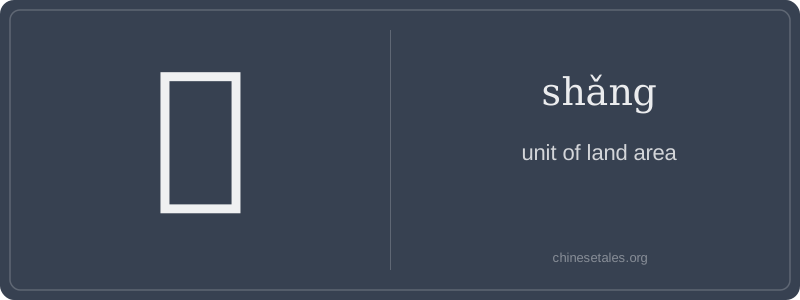
The earliest trace of 垧 appears not in oracle bones (it’s too late for that), but in Song–Yuan dynasty regional scripts, where it emerged as a phonosemantic compound: the left radical 土 (tǔ, ‘earth/soil’) anchors its meaning, while the right component 尚 (shàng, ‘still, yet; esteemed’) provides the sound — though pronounced shǎng here, not shàng. Visually, the nine strokes coalesce into a grounded, balanced shape: three horizontal lines in 土 suggest layered soil, while 尚’s structured upper part (⺌ + 一 + 八 + 口) evokes orderly plots — like terraced fields viewed from above.
By the Ming dynasty, 垧 was documented in Guangdong land registers as a local unit for rice paddies and orchards. Unlike standardized units imposed by central governments, 垧 grew organically from peasant practice — one 垧 was roughly the amount of land a family could manage with a single ox and plow in a season. The character’s form never changed dramatically because its usage remained hyperlocal and functional, not literary. No classical poetry celebrates it, but old Cantonese folk songs whisper its rhythm: ‘一垧禾,两垧蔗,三垧荔枝红满树’ — a living metric of life itself.
Think of 垧 (shǎng) as China’s quiet, rural cousin to the more familiar ‘mu’ (亩) — a unit of land area used almost exclusively in southern China, especially Guangdong and Fujian. It’s not abstract or bureaucratic: one 垧 equals about 15 mu (roughly 1 hectare or 2.5 acres), but its real flavor lies in its earthy, local texture. You won’t see it on national land deeds or in Beijing office memos — it lives in village records, family land contracts, and oral histories. It feels tactile, like soil under fingernails, not spreadsheets.
Grammatically, 垧 behaves like any measure word for area: it follows a number and precedes the noun, often with 的 — e.g., ‘三垧地’ (sān shǎng de dì), meaning ‘three shǎng of land’. Crucially, it *never* stands alone — you can’t say ‘这垧很大’; it must be ‘这三垧地很大’. Learners sometimes mistakenly treat it like a noun or omit the required noun (地, 田, etc.), leading to unnatural or incomprehensible phrases.
Culturally, 垧 is a linguistic fossil — preserved in dialects while fading from official use. It reflects how land measurement was deeply tied to local ecology and farming practice, not imperial standardization. A common mistake? Confusing it with 响 (xiǎng, ‘sound’) or 向 (xiàng, ‘toward’) due to similar pronunciation — but those have zero connection to land. If you hear ‘shǎng’ in a Guangdong farm story, think dirt, not decibels.