垣
Character Story & Explanation
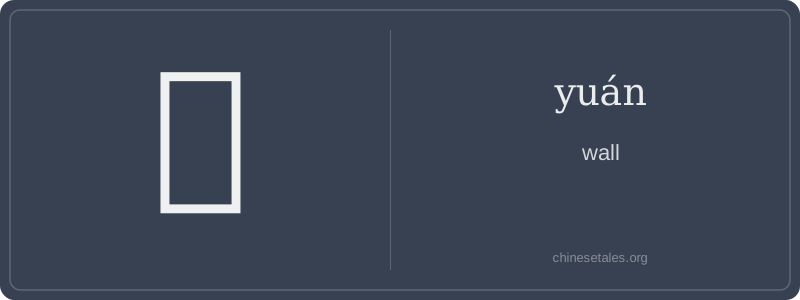
The earliest form of 垣 appears in bronze inscriptions as a vivid pictograph: two parallel vertical lines (representing upright earthen embankments) flanking a central element — not a person or gate, but a stylized mound of packed earth (土), sometimes with reinforcing stakes or horizontal beams. Over centuries, the flanking lines simplified into the left and right 'walls' (the outer strokes), while the central 土 radical anchored its meaning firmly in earthwork construction. By the seal script era, the structure had crystallized into today’s nine-stroke form: 土 on the left, and 口 (originally representing a fortified enclosure, not ‘mouth’) on the right — though modern eyes might misread 口 as ‘mouth’, it’s really a symbolic square fortification.
This character didn’t just describe mud walls — it encoded political order. In the Zuo Zhuan, states were measured by their ‘three gates and nine 垣’, signifying sovereignty. By the Tang dynasty, poets like Du Fu used 垣 to contrast human fragility against enduring stone — ‘broken walls’ (断垣) became a stock image of fallen glory. Even today, when a scholar writes of ‘cultural 垣’, they invoke an invisible yet formidable boundary of tradition — proof that this nine-stroke character still guards meaning, not just space.
垣 (yuán) isn’t your everyday ‘wall’ — it’s the kind of wall that stands tall in poetry and history: a sturdy, boundary-defining earthen rampart, often surrounding ancient cities or noble estates. Think less 'drywall' and more 'Great Wall’s quieter cousin' — it carries weight, dignity, and a faint echo of classical authority. Its core sense is *enclosing, protective, enduring* — never temporary or decorative.
Grammatically, 垣 is almost exclusively literary or formal. You won’t hear it in casual speech ('I’ll build a wall') — instead, it appears in set phrases like 东垣 (dōng yuán, 'eastern rampart') or as part of compound nouns (e.g., 城垣). It functions primarily as a noun, rarely as a verb, and almost never takes aspect markers like 了 or 过. Learners mistakenly try to use it like 墙 (qiáng), but swapping them is like calling Buckingham Palace ‘a fence’ — technically enclosing, but wildly off-register.
Culturally, 垣 evokes the walled world of pre-modern China: city walls defining safety vs. chaos, garden walls framing scholarly retreats, even metaphorical ‘walls’ of social decorum. In classical texts, it often symbolizes stability — hence phrases like ‘金汤城垣’ (jīn tāng chéng yuán, 'golden-soup city walls'), meaning impregnable defense. A common pitfall? Overusing it in writing — native speakers reserve it for essays, historical fiction, or formal inscriptions. If you’re describing your apartment’s brick wall, stick with 墙.