垢
Character Story & Explanation
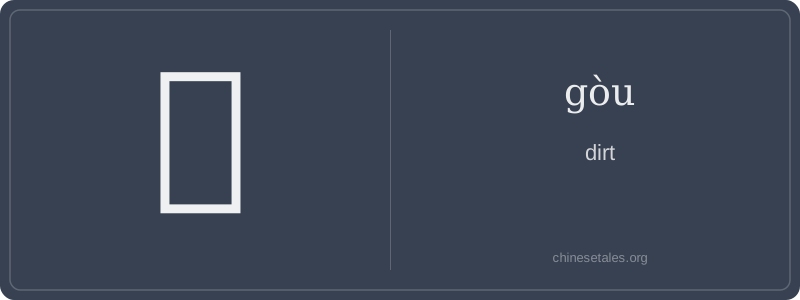
The earliest form of 垢 appears in Warring States bamboo slips—not as a pictograph, but as a phonosemantic compound: the left side 土 (tǔ, ‘earth’) signals its domain (physical matter, impurity), while the right side 后 (hòu, ‘after, later’) originally served as a phonetic clue (though pronunciation shifted from *hòu* to *gòu* over time). Visually, the modern 9-stroke form preserves this structure: three horizontal strokes for 土 at the bottom, and six strokes above forming 后—its vertical line, two short horizontals, and final long stroke mimicking a person’s back and trailing garment, subtly reinforcing the idea of something *left behind*, accumulating over time.
This ‘left-behind’ nuance shaped its semantic evolution. In the *Zhuangzi*, 垢 describes the mental residue obstructing true perception; in Tang dynasty poetry, it’s the tarnish on a bronze mirror symbolizing lost virtue. Unlike simple dirt, 垢 implies duration and resistance—it’s not what falls *on*, but what sticks *through*. Its presence in medical texts (e.g., describing plaque on teeth or tongue coating) confirms this sense of tenacious accumulation. The character didn’t just name dirt—it named dirt’s biography.
Imagine scrubbing an ancient bronze ritual vessel in a museum lab—your gloves blacken with centuries of accumulated grime clinging stubbornly to the inscriptions. That sticky, layered, almost *living* dirt isn’t just dust or mud; it’s 垢 (gòu): a word that evokes thick, ingrained filth—not surface-level mess, but the kind that has *settled*, hardened, and resisted casual cleaning. It’s not neutral like 尘 (chén, 'dust') or generic like 脏 (zāng, 'dirty'); 垢 carries weight, age, and moral resonance—it’s the ‘stain’ on reputation, the ‘crust’ on neglected duty.
Grammatically, 垢 is almost never used alone. You won’t say *‘This plate is gòu’*—it appears in compounds (like 污垢 wūgòu, ‘filth’) or poetic/technical contexts. It functions as a noun, rarely a verb, and is strongly associated with classical or formal registers. Learners often misapply it like a synonym for ‘dirt’ in everyday speech—but native speakers would say 污渍 (wūzì, ‘stain’) or 油污 (yóuwū, ‘grease’) instead. Using 垢 casually sounds archaic or hyperbolic—like calling a coffee ring ‘a sedimentary stratum’.
Culturally, 垢 appears in Daoist texts describing the ‘dross’ (wùgòu) one must shed to attain clarity, and in Confucian critiques of ‘moral crust’—corruption that calcifies over time. Its radical 土 (tǔ, ‘earth/soil’) anchors it in the physical world, while its right side (后) hints at something *left behind*, lingering. Mistake it for a general-purpose ‘dirt’ word, and you’ll sound like someone quoting Zhuangzi at a laundromat.