垡
Character Story & Explanation
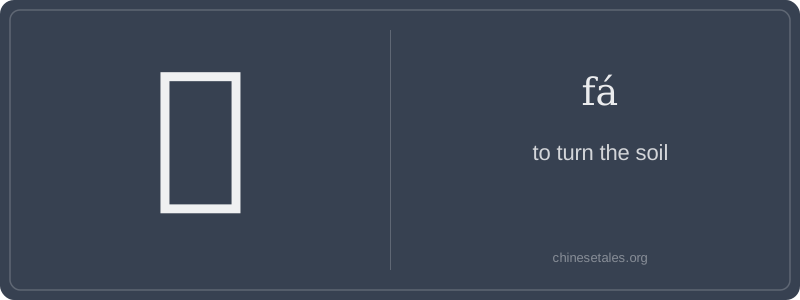
The earliest form of 垡 appears in Han dynasty bamboo slips and later in Song-era agricultural compendia — not oracle bones (it’s too late for that), but its structure is brilliantly pictographic. Look closely: the left side is 土 (tǔ), the 'earth' radical — solid, grounded. The right side is 伐 (fá), which originally depicted a person wielding an axe ( + 戈). In 垡, 伐 isn’t about chopping trees; it’s repurposed as a *phonetic-semantic compound*: the axe-like motion mirrors the downward-and-upward thrust of a spade cutting into and lifting soil. Over centuries, the strokes simplified — the 'axe' (戈) became stylized, and the 'person' (亻) merged with the blade, yielding today’s clean 9-stroke form.
This semantic fusion — 土 + 伐 — crystallized during the Tang-Song transition, when agricultural treatises like The Four Seasons of Farming began standardizing technical vocabulary. Classical texts used 垡 to distinguish *deep, preparatory tilling* from surface raking or harrowing. Interestingly, the character was so tied to manual labor that it rarely appeared in elite poetry — yet when it did (e.g., in Yuan dynasty pastoral verse), it carried quiet dignity: the farmer wasn’t just working land; he was conversing with it, turning it over like a page.
垚 (fá) is a wonderfully earthy, action-oriented character — it doesn’t just mean 'to turn the soil'; it evokes the physical act of flipping clods with a spade, breaking up compacted earth to prepare for planting. Unlike generic verbs like 翻 (fān) or 耕 (gēng), 垡 carries an almost tactile weight: it’s specific to *uprooting and inverting* topsoil — think late winter fieldwork before spring sowing. You’ll rarely see it in daily conversation; it lives in agricultural manuals, regional dialects (especially northern rural speech), and classical farming texts.
Grammatically, 垡 is almost always a verb, used transitively (e.g., 垡地 — 'to turn the soil') and occasionally as a noun meaning 'turned soil' in poetic or technical contexts. It never stands alone — you won’t say 'I 垡'; you say '我用铁锹垡地' ('I turn the soil with a spade'). Learners often misread it as fā or fǎ due to its shape, but the tone is firmly second-tone fá — like 'fa' in 'father' with a rising lift. Also, don’t confuse it with the similar-looking 发 (fā); that one has no 土 radical and means 'to send out' or 'to issue'.
Culturally, 垡 reflects China’s deep agrarian roots: this isn’t abstract labor — it’s seasonal, muscular, and tied to soil health and fertility cycles. Modern urban learners may never use it, but encountering 垡 is like holding a fossilized verb — one that still pulses with the rhythm of ploughing, seed-time, and the quiet authority of land stewardship.