垠
Character Story & Explanation
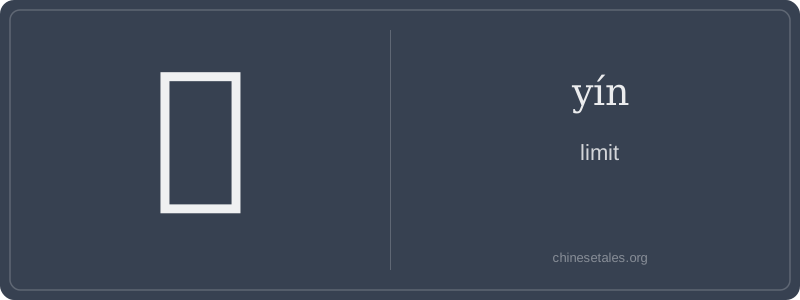
The earliest form of 垠 appears in Warring States bamboo slips as a compound: left side 土 (tǔ, 'earth') + right side 银 (yín, 'silver') — but wait! That's a later phonetic loan. Actually, the original bronze script showed 土 topped by a simplified depiction of a distant mountain range (like three peaks) — not silver, but a visual echo of 'far-off land'. Over centuries, the peaks stylized into the radical 丿 (piě) and two short strokes above, while the lower right evolved from a phonetic element meaning 'to extend' (艮 gèn), eventually merging into today’s 丨+一+丿+丶 structure — all anchored firmly on earth.
This grounding in 土 is key: 垠 doesn’t mean abstract 'limit' like a math bound — it means the physical, visible edge of habitable land: where soil gives way to sea, desert, or sky. In the Classic of Mountains and Seas, 垠 marks borders of mythic realms; in Du Fu’s poems, 无垠 describes the Gobi’s silence — not emptiness, but a presence so vast it erases measurement. Its shape — earth supporting the unreachable — is literally its philosophy: limits aren’t barriers, but thresholds of reverence.
Think of 垩 (yín) not as a dry dictionary 'limit' — but as the Chinese equivalent of the horizon line in a Renaissance painting: that precise, hushed boundary where earth and sky refuse to merge, yet hold each other in silent tension. In classical and literary Chinese, 垠 almost never stands alone; it’s a poetic anchor, always paired — like 'boundless' (无垠 wú yín) or 'endless' (无际无垠 wú jì wú yín). It’s the 'edge' you can’t cross, not because of walls or rules, but because the very idea of crossing dissolves the moment you approach it.
Grammatically, 垠 is exclusively a noun (never a verb or adjective), and it demands negation or amplification: you’ll see it with 无 (wú, 'without'), 极 (jí, 'extreme'), or 绝 (jué, 'absolute') — but never *just* 'this limit' or 'the limit'. Learners often wrongly insert it into modern spoken sentences like '我的时间有很明显的垠' — which sounds like quoting a Tang dynasty poet mid-sentence at a coffee shop. It belongs to written elegance, not WhatsApp texts.
Culturally, 垠 carries quiet awe — it’s the edge of human perception, not bureaucracy. Mistake it for a bureaucratic 'limit', and you’ll miss its spiritual weight: in Su Shi’s poetry, 无垠 isn’t about scarcity — it’s about cosmic humility. And beware: its soft 'yín' sound tempts learners to misread it as yǐn (like 引) or yìn (like 印); the tone is level and light, like breath held at the rim of a cliff.