垟
Character Story & Explanation
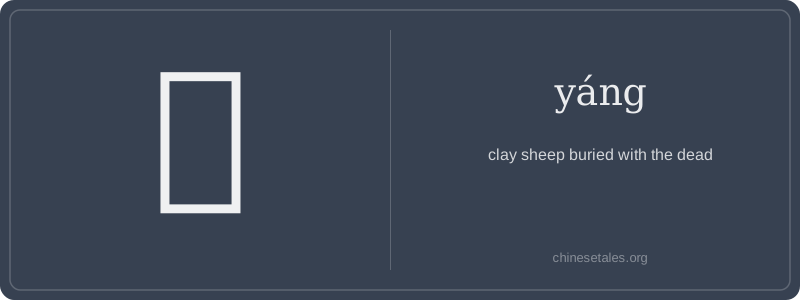
The earliest form of 垟 appears on late Shang oracle bones and bronze inscriptions as a highly pictographic compound: a simplified outline of a sheep’s head (羊) placed directly above a horizontal line representing earth (土). Over centuries, the羊 element standardized into its modern script form — horns curving inward, body compact — while the 土 radical gained its two short horizontal strokes and vertical stem, anchoring the whole character visually and semantically in the realm of burial grounds. No extra strokes were added; no components were rotated — it’s a remarkably stable, unadorned fusion of ritual intent and material context.
This visual pairing wasn’t arbitrary. In Shang cosmology, sheep were auspicious sacrificial animals associated with purity and communication with ancestors — and burying them *in clay*, rather than flesh, served both practical (preservation) and symbolic (transformation of life into enduring form) purposes. The character appears in bronze vessel inscriptions recording royal funerary inventories, such as the inscription on the late Shang ‘Yong Ding’ tripod, where 垟 is listed alongside jade bi discs and bronze bells — all items meant to accompany the deceased into the afterlife. Its shape remains unchanged because its function was so narrowly defined: not a word for 'sheep', but a label for a specific funerary artifact — a clay sheep, earth-bound, eternal.
Let’s get one thing straight: 垟 (yáng) is not a character you’ll encounter in daily conversation, textbooks, or even most dictionaries — it’s an archaeological whisper from China’s Shang dynasty tombs. Its core meaning — 'clay sheep buried with the dead' — isn’t metaphorical or poetic; it’s literal, ritual-specific, and deeply tied to early Chinese ancestor veneration. Visually, it’s a rare compound of 土 (tǔ, earth/soil) and 羊 (yáng, sheep), but don’t mistake it for a generic 'earth + sheep' blend — this is a ceremonial object: a molded clay ram placed in elite graves as a symbolic sacrifice, not food, but spiritual currency.
Grammatically, 垟 functions almost exclusively as a noun — never a verb, never an adjective, and certainly never in modern compounds like 'sheep farm' or 'clay art'. You won’t say 'I made a 垟'; you’d say 'The tomb contained three 垟' — and even then, only in academic archaeology reports or classical annotation texts. Learners often misread it as 羊 (yáng) alone or confuse its 土 radical with 地 (dì, ground), but 垟 has zero connection to geography or livestock husbandry. It’s a fossilized ritual term — like finding the word 'censer' in English and using it only when describing Tang-dynasty Buddhist altars.
Culturally, its rarity is the point: 垟 reflects how tightly language encoded religious practice in ancient China. Its near-total disappearance after the Western Zhou signals a shift from tangible clay offerings to textual or jade-based rituals. Modern learners rarely need it — but recognizing it reveals how much meaning can be packed into a single, forgotten glyph: not just 'sheep', but 'sacrificial sheep, formed by human hands, placed beneath the earth, for the unseen world'.