垞
Character Story & Explanation
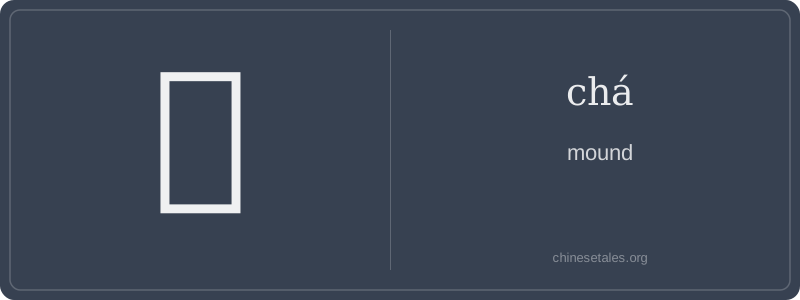
The earliest form of 垞 appears in late Warring States bamboo slips (c. 300 BCE), not oracle bones — and it’s strikingly literal: a left-side radical 土 (tǔ, ‘earth’) anchoring the character, paired with 叉 (chā), which here isn’t ‘fork’ but a stylized depiction of *two converging ridges* rising symmetrically from ground level — like twin arms cradling soil into a soft, symmetrical mound. Over centuries, 叉 simplified: its two diagonal strokes flattened and fused at the top, becoming the modern ‘叉’-like top (actually written as + 丶 in standard form), while 土 remained unaltered — preserving the earth-rooted essence.
This visual logic held firm across dynasties: in the Han dynasty’s Shuōwén Jiězì, 垞 is defined as ‘a small earthen rise’ (小阜也), distinguishing it from 阜 (fù, a larger, fortified mound) and 丘 (qiū, a natural hill). It appears in the 1st-century CE commentary on the Rites of Zhou describing ritual earth mounds for seasonal offerings — always low, unplanted, and unfortified. Its shape never strayed from its core idea: earth gently gathered by hand or time — not carved, not piled high, but *settled*. That quiet, unassuming dignity remains embedded in every stroke.
Think of 垞 not as a dusty dictionary word, but as a quiet, earthy whisper from ancient China — it’s a ‘mound’, yes, but specifically one that rises naturally from the land: a gentle swell in a field, a burial tumulus, or the low, rounded hump of a hill seen on the horizon. It carries a soft, grounded weight — never sharp or jagged like a mountain (山), and never artificial like a dam (坝). In classical texts, it often appears in poetic or ritual contexts describing sacred earth formations, and today it survives almost exclusively in literary, historical, or geographical compounds — you won’t hear it in daily chat or HSK dialogues.
Grammatically, 垞 is a noun only — no verb forms, no adjectival use. It doesn’t take aspect particles like 了 or 过, nor does it pair with measure words like 个; instead, it appears with classifiers like 座 (zuò) for large mounds or 封 (fēng) in classical tomb nomenclature. Learners sometimes misread it as chá (tea) due to identical pinyin, leading to comical mental images of 'tea mounds' — but there’s zero semantic link. Also, avoid overgeneralizing: while it *can* mean ‘hill’, it’s never used for steep or prominent terrain — that’s 山 or 岭. This precision matters in classical poetry, where choosing 垞 over other ‘elevation’ characters evokes humility, antiquity, and quiet permanence.
Culturally, 垞 resonates with China’s deep-rooted geomantic (fengshui) sensibility — mounds weren’t just topography; they marked ancestral graves, spirit boundaries, or auspicious landforms. Modern readers may miss this layer entirely, reducing it to ‘lump of dirt’. But in the Book of Songs (Shījīng), phrases like ‘丘垞之间’ (between hills and mounds) evoke pastoral stillness and human-scale harmony with earth — a nuance lost if translated flatly as ‘hills and bumps’.