垝
Character Story & Explanation
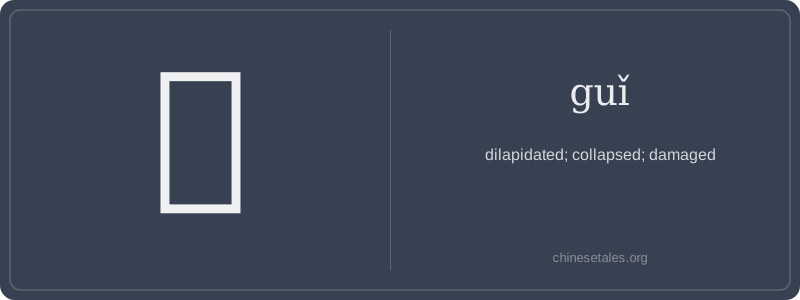
The earliest form of 垝 appears in bronze inscriptions as a compound pictograph: on the left, a simplified 土 (tǔ, 'earth/soil') radical, and on the right, a stylized representation of a *collapsed wall* — originally drawn with jagged, leaning strokes suggesting fractured masonry and slumping mortar. Over centuries, the right-hand side evolved from a detailed sketch of crumbling stone into the modern 危 (wēi, 'precarious') component — retaining the sense of instability but shedding literal detail. The character’s structure — earth + danger — was deliberate: in ancient China, a wall wasn’t just architecture; it was defense, order, and sovereignty. A 垝 wall signaled vulnerability — both physical and political.
This meaning solidified in early texts: the Shījīng (Book of Odes, c. 11th–7th BCE) uses 垝垣 (guǐ yuán) to describe the ruined watchtower where a woman waits in vain for her lover — turning structural decay into emotional desolation. Later, scholars like Zheng Xuan (2nd c. CE) glossed 垝 as 'walls bent by wind and rain, no longer upright', emphasizing posture over rupture. Even today, when writers use 垝, they’re not describing renovation needs — they’re invoking silence, memory, and the quiet dignity of things that have outlived their purpose.
Think of 垝 (guǐ) as the Chinese equivalent of the word 'crumbling' in Gothic horror — not just broken, but hauntingly *unstable*, like a mansion’s turret sagging after decades of rain. It doesn’t mean ‘broken’ in the clean, functional sense (like 碎 shuì, 'shattered'), nor does it imply intentional demolition (like 拆 chāi). Instead, 垝 evokes slow, organic decay — walls warped by time, beams bent by neglect, structures that haven’t collapsed *yet*, but groan under their own weight. You’ll almost never hear it in daily speech; it lives in classical poetry, historical descriptions, or literary essays about abandoned places.
Grammatically, 垝 is almost always an adjective preceding a noun (e.g., 垝垣 guǐ yuán — 'crumbling wall') and rarely stands alone. It never takes aspect particles like 了 or 过, nor does it combine with degree adverbs like 很 — saying '很垝' sounds deeply unnatural to native ears. Instead, it often appears in fixed classical compounds or paired with words like 垣 (wall), 城 (city wall), or 室 (room). Its rarity means learners who encounter it usually do so in texts quoting the Book of Odes — where its melancholy weight carries emotional gravity far beyond mere physical damage.
Culturally, 垝 isn’t neutral: it’s poetic shorthand for loss, abandonment, or the passage of dynasties. Learners sometimes misread it as a variant of 诡 (guǐ, 'deceitful') due to identical pronunciation and shared phonetic component — a classic trap that swaps architectural decay for moral ambiguity! Also, don’t confuse it with common modern words like 坏 (huài); 垝 feels ancient, literary, and visually heavy — like stepping into a Tang dynasty ink painting where every cracked brick tells a story.