垚
Character Story & Explanation
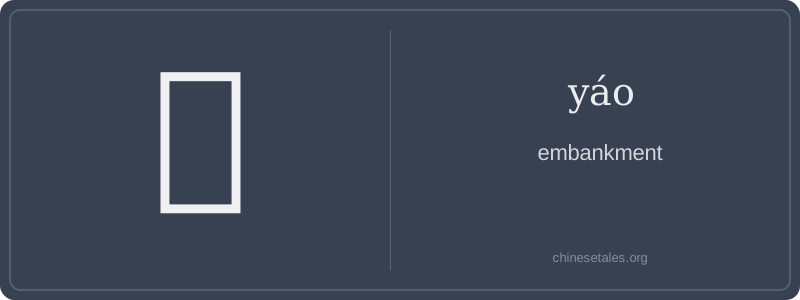
The earliest form of 垚 appears in late Shang oracle bone inscriptions as three distinct, stacked horizontal lines — each representing a layer of packed soil — flanked by two vertical strokes suggesting containment or boundary. Over centuries, those lines evolved into three full 土 radicals, each retaining its complete structure (two horizontal strokes, a vertical stroke, and a final downward hook), arranged top-to-bottom. This wasn’t stylization — it was amplification: every 土 is intentional, reinforcing height and density. By the Han dynasty clerical script, the three 土 were standardized in strict vertical alignment, creating the balanced, symmetrical shape we see today — a visual echo of terraced earthworks.
Its meaning stayed remarkably consistent: from early bronze inscriptions describing 'the sovereign’s mound' (referring to ritual earthen altars) to Tang poetry praising 'mountains rising on ancient 垚,' the character always implied engineered elevation — not natural hills, but human-constructed earth masses. Confucian texts subtly linked it to virtue: just as layered earth supports life, moral cultivation requires cumulative, deliberate effort. Its triple repetition isn’t redundancy — it’s emphasis: true stability isn’t one layer deep. It’s three.
垚 (yáo) is a beautifully rare character — it looks like three stacked earths (土), and that’s exactly what it means: 'a high, solid embankment' or 'mound of earth.' In classical Chinese, it evokes stability, elevation, and human mastery over terrain — think ancient flood-control walls or ceremonial earthen platforms. It’s not abstract; it’s tactile, grounded, and architectural in feel. You won’t hear it in daily speech, but when you do, it carries poetic weight — like describing a mountain’s base as 'unshakable 垚.'
Grammatically, 垚 functions almost exclusively as a noun or descriptive noun modifier — never as a verb or independent pronoun. It rarely appears alone; instead, it shines inside names (especially given names, where it conveys strength and rootedness) or literary compounds like 垚基 (yáo jī, 'earthen foundation'). Learners sometimes misread it as a variant of 尧 (yáo, 'eminent'), but they share only pronunciation — not meaning or origin. And no, it’s not used for modern infrastructure terms like 'dike' (that’s 堤 dī); 垚 is deliberately archaic and dignified.
Culturally, 垚 is a quiet powerhouse: it’s one of the most common characters in Chinese personal names — especially for girls — precisely because its triple-earth structure symbolizes deep roots, resilience, and harmony with nature. But here’s the trap: many learners assume it’s a simplified or variant form of another character. It’s not. It’s ancient, self-contained, and unapologetically literal: three layers of earth = something tall, firm, and enduring. If you see it, pause — you’re looking at geology made glyph.