垙
Character Story & Explanation
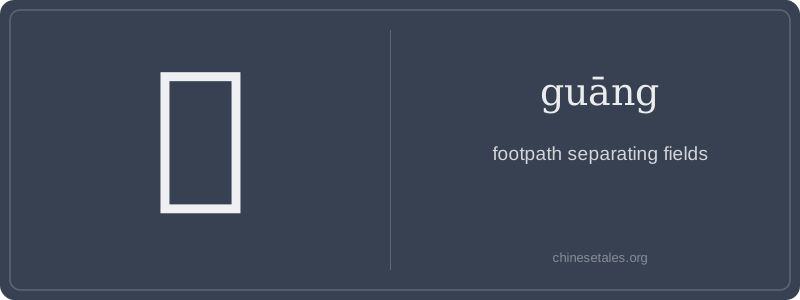
The earliest form of 垅 appears in Han dynasty seal script—not oracle bone or bronze, since it’s a relatively late semantic compound. Its left radical 土 (tǔ, 'earth') anchors it firmly in the soil, while the right side 龙 (lóng, 'dragon') was originally a phonetic component, not a pictograph of the mythic beast. Over centuries, 龙 simplified visually in this context, losing its clawed limbs and curving into the streamlined 龙 we see today—yet retaining its sound value. The stroke count (9 total) stabilized early: three for 土, six for 龙—no extra flourishes, just earth + sound, clean and utilitarian.
Historically, 垅 entered written records via agricultural manuals like the Qimin Yaoshu (c. 540 CE), where it described raised beds for drought-resistant millet cultivation. Unlike abstract terms for 'boundary', 垅 always implied human labor: a ridge *shaped* by hoeing, not merely observed. Its visual pairing—earth plus dragon—may seem odd, but in ancient phonology, 龙 served purely as a sound cue for the 'long' /lǒng/ syllable, much like using 'knight' to hint at 'night' in English spelling. No dragons were harmed—or summoned—in farming.
Think of 垙 (guāng) as China’s version of a 'farm lane'—not the paved country road you’d see in Vermont, but the narrow, earth-packed strip farmers tread between rice paddies or wheat fields, like the raised earthen borders you might spot in a Japanese zen garden or an English hedgerow map. It’s not a path for people to walk on casually; it’s functional infrastructure: a drainage divider, a boundary marker, and sometimes even a tiny levee—all rolled into one quiet, unassuming line of packed soil.
Grammatically, 垙 is almost always a noun, rarely used alone, and nearly never as a verb or adjective. You’ll find it embedded in compound nouns (like 田垅 or 垅沟) or modified by classifiers like 条 (a long thin object): 一条垅 (yī tiáo lǒng). Learners often mistakenly treat it like 路 (lù, 'road') or 道 (dào, 'path')—but 垙 carries no connotation of travel or destination; it’s strictly agrarian geography. Using it in urban contexts (e.g., 'the subway 垅') would sound absurdly poetic—or just wrong.
Culturally, 垙 reflects how deeply Chinese writing encodes land stewardship: every character for field division (垅, 埂, 畈, 畦) tells a micro-story about water management, property lines, and seasonal labor. A common learner trap? Confusing 垅 with 隆 (lóng, 'prosperous') due to similar pronunciation—but they share zero semantic ground. Also, don’t assume it’s interchangeable with 垄 (lǒng), its simplified variant; while 垅 is traditional, both mean the same thing—but 垅 appears in classical texts and regional dialects more frequently, giving it a slightly more literary, rural resonance.