垗
Character Story & Explanation
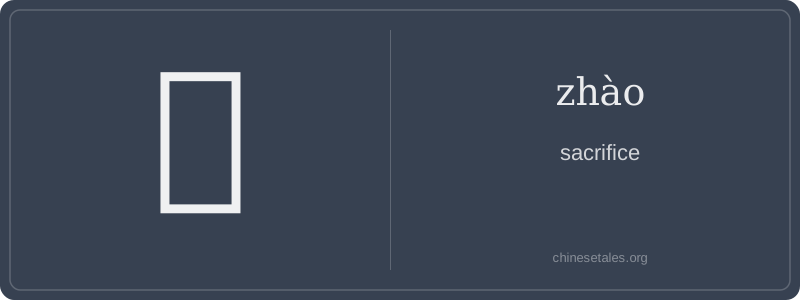
The earliest form of 垗 appears in Western Zhou bronze inscriptions as a compound pictograph: at the top, a stylized 'altar' (the radical 土, 'earth') beneath which flows liquid (a bent line representing wine being poured), and to the right, a hand holding a vessel — sometimes even with a drop falling toward the earth. Over centuries, the hand and vessel merged into the right-side component 召 (zhào), while the altar base solidified into 土. By the Qin seal script, the character had stabilized into its current structure: 土 + 召 — literally 'earth-summoning', evoking the ritual act of calling spirits to witness the pouring of sacred wine onto the ground.
This visual logic directly shaped its meaning: 垗 wasn’t just offering — it was invocation through consecrated gesture. In the *Zuo Zhuan*, it appears in pivotal moments: when feudal lords swore mutual defense pacts, or when ministers vowed loyalty after a succession crisis. The character’s enduring power lies in that fusion of soil (the mortal realm), liquid (life force), and summons (intention). Even today, when scholars reconstruct Zhou rituals, 垗 is the keystone term — not because it’s common, but because it encodes the very grammar of ancient Chinese political theology.
Think of 垗 (zhào) not as a generic 'sacrifice' like giving up dessert for Lent, but as the ancient Chinese equivalent of signing a blood oath — solemn, ritual-bound, and deeply contractual. In classical texts, it refers specifically to the act of swearing allegiance or sealing a covenant by offering sacrificial wine (often poured on earth or altar), invoking divine witness. It’s not about loss or suffering; it’s about binding commitment — more like a notarized vow than a penitential act.
Grammatically, 垗 is almost exclusively a verb in classical and literary contexts, rarely used alone today. You’ll encounter it mainly in set phrases (e.g., 垗誓 — 'to swear an oath') or historical narratives. Crucially, it never takes aspect markers like 了 or 过 in modern usage — trying to say *我垗了* would sound jarringly archaic or nonsensical to native ears. Instead, it appears in formal, ceremonial registers: official declarations, historical dramas, or academic writing on Zhou dynasty rites.
Culturally, learners often misread 垗 as synonymous with 祭 (jì, 'to sacrifice to ancestors') or 贡 (gòng, 'tribute'), but those imply hierarchy (human→deity/sovereign), whereas 垗 implies parity and mutual obligation — two parties pledging before heaven. A common mistake is overusing it in spoken Mandarin; it’s virtually absent from daily conversation. If you hear it, you’re likely listening to a documentary narrator quoting the *Zuo Zhuan* — not your friend ordering dumplings.