垔
Character Story & Explanation
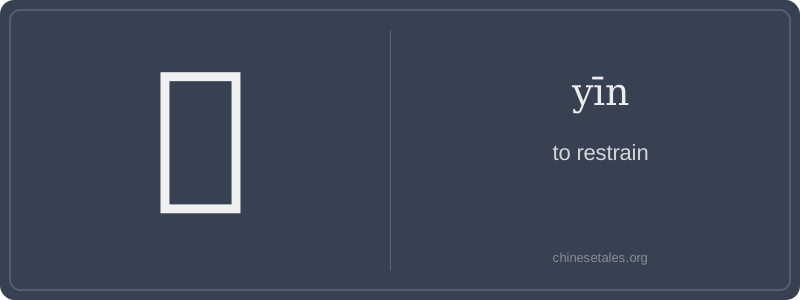
The earliest form of 垔 appears on Warring States bamboo slips as a compound pictograph: a simplified 土 (earth/ground) radical at the bottom, topped by a stylized glyph resembling two crossed arms or binding cords — not the modern 尹, but an early sign for 'to bind' or 'to regulate'. Over centuries, that top element evolved into 尹 (yǐn, 'to govern'), likely due to phonetic borrowing and semantic reinforcement — since rulers were expected to 'restrain' chaos. By the Han dynasty clerical script, the shape stabilized: 土 firmly anchored below, 尹 above, nine strokes forming a compact, balanced structure — visually embodying 'control grounded in stability'.
This evolution reflects how Chinese conceptualized restraint: not as absence, but as active, earth-bound order. In the Xunzi, 垔 appears in passages urging scholars to 垔私欲 (yīn sī yù, 'restrain private desires') to cultivate public virtue — linking moral discipline to physical grounding. The character’s visual weight (solid 土 base + authoritative 尹 top) mirrors this philosophy: true restraint isn’t floating idealism; it’s deeply rooted practice. Even today, its rarity makes each appearance feel like a deliberate invocation of classical ethical gravity.
Think of 垔 (yīn) as the Chinese linguistic equivalent of a velvet-lined iron glove: outwardly soft and earthy (thanks to its 土 radical), but hiding firm, deliberate control. Its core meaning — 'to restrain', 'to hold back', or 'to curb' — isn’t about brute force like 打 (dǎ, 'to hit') or 禁 (jìn, 'to forbid'), but rather about measured, grounded containment — like a dam holding back water, or a wise elder gently checking an impulsive youth. It carries quiet authority, not shouting command.
Grammatically, 垔 is almost exclusively literary or classical in modern usage — you’ll rarely hear it in daily speech. It appears mainly as a verb in formal writing, often paired with abstract nouns: 垔欲 (yīn yù, 'restrain desire'), 垔怒 (yīn nù, 'suppress anger'). It’s never used alone in colloquial sentences; saying *'wǒ yīn tā'* ('I restrain him') would sound archaic or poetic — like saying 'I doth forbear' in English. Learners mistakenly treat it like a common verb, but it functions more like a cultivated brushstroke in calligraphy: precise, intentional, and reserved for contexts where gravity matters.
Culturally, 垔 echoes Confucian ideals of self-cultivation — restraining base impulses to align with virtue (德). A classic mistake is confusing it with the far more common 抑 (yì, 'to suppress'), which implies active, sometimes anxious effort, whereas 垔 suggests rooted, stable restraint — like soil holding roots in place. Using 垔 where 抑 is expected can unintentionally evoke ancient ritual texts instead of modern essays!