垓
Character Story & Explanation
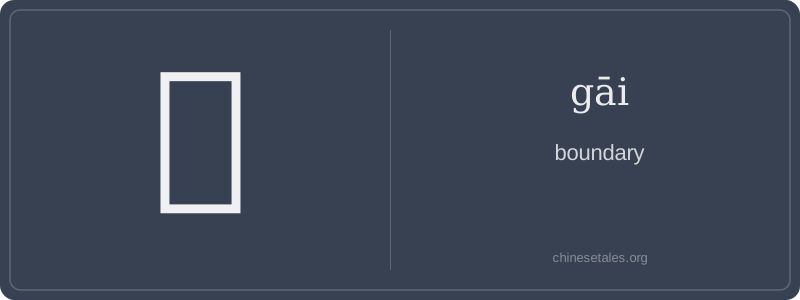
The earliest form of 垓 appears in bronze inscriptions as a compound: 土 (tǔ, 'earth/soil') on the left, and 亥 (hài, originally a pictograph of a pig’s head with curling tail, later repurposed as the 12th Earthly Branch) on the right. In oracle bone script, 亥 may have depicted a boundary marker post planted in earth — its curving strokes suggesting both enclosure and cyclical completion. Over centuries, the pig-head evolved into the stylized 亥 we know today, while 土 retained its three horizontal strokes and vertical line, grounding the character literally and semantically in terrain.
This visual logic — earth + 亥 — encoded the idea of a defined territorial limit, especially one marking the farthest reach of a domain. By the Warring States period, 垓 appeared in texts like the *Zuo Zhuan* to denote the outermost zones of Zhou feudal territories. Its association with finality intensified after the Battle of Gaixia (202 BCE): the place name 'Gaixia' (literally 'Boundary Below') became synonymous with last stands and cosmic thresholds. Even today, the character’s shape feels tectonic — solid (土) yet subtly curved (亥), as if holding the weight of an empire’s edge.
Think of 垓 (gāi) as the ancient Chinese word for 'boundary' — but not the tidy, modern kind marked on a map. It’s the raw, rugged edge of things: where land meets sky, army meets enemy, or life meets legend. Its core feeling is liminality — a charged, almost mythic threshold. You’ll rarely hear it in daily speech; it lives in classical poetry, historical texts, and place names, carrying weight and solemnity. Unlike common boundary words like 边界 (biānjiè) or 界限 (jièxiàn), 垓 evokes scale and fate — it’s less 'border control' and more 'the last ridge before oblivion.'
Grammatically, 垓 functions almost exclusively as a noun, often modified by numerals or poetic descriptors. It appears in fixed phrases like 四面八方 (sìmiàn bāfāng) + 垓 — as in 四垓 (sì gāi, 'four boundaries'), meaning the cardinal directions extended to their utmost limits. Crucially, it never stands alone as a verb ('to bound') or adjective ('boundary-like'); learners sometimes mistakenly try to use it that way — e.g., *'这个区域垓了' — which is ungrammatical and nonsensical. It only works in set literary or geographic terms.
Culturally, 垓 carries deep resonance from the Chu–Han Contention (206–202 BCE). The most famous usage is in '垓下之围' (Gāixià zhī wéi) — the Siege of Gaixia — where Xiang Yu, the doomed Hegemon-King, was encircled and sang his final lament. This event burned 垓 into the Chinese literary imagination as a symbol of irrevocable turning points and existential edges. Modern learners rarely encounter it outside historical readings or poetic allusions — so when you see it, treat it like finding an ancient coin: rare, heavy with story, and best handled with respect.