垏
Character Story & Explanation
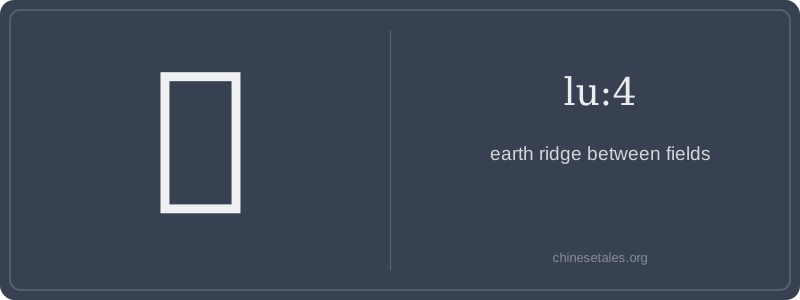
The earliest form of 垅 appears in Han dynasty bamboo slips and early clerical script — not oracle bones (too late for that), but still ancient. Visually, it’s a masterclass in semantic economy: the left radical 土 (tǔ, ‘earth’) anchors it firmly in the soil, while the right side 隆 (lóng, ‘swelling, rising’) isn’t just phonetic — it’s pictorially evocative. In seal script, 隆 showed a hill-like curve above a ‘city gate’ element, suggesting upward bulge; over centuries, this softened into the modern 隆 shape, preserving the sense of gentle elevation. The full character thus literally ‘draws’ an earthen swell — not a mountain, but a purposeful, human-scaled rise.
By the Tang dynasty, 垅 appeared in agricultural manuals like the Simin Yue Ling (‘Monthly Ordinances for the Four Classes’), describing ridge-and-furrow planting techniques that maximized drought resistance. Poets like Du Fu referenced ‘field ridges’ (田垅) to evoke quiet rural order — contrasted with chaotic war-torn roads. Crucially, the character’s visual balance mirrors its function: the solid, grounded 土 on the left, the rising 隆 on the right — a perfect graphic metaphor for how farmers turned flat, vulnerable land into organized, resilient space. Even today, when you see the character, you’re seeing 2,000 years of soil science in one glyph.
Think of 垏 (lù) as the quiet, uncelebrated backbone of traditional Chinese agriculture — not a crop, not a tool, but the humble earthen ridge that separates one field from another. It’s a concrete, physical feature: a low, linear mound of packed soil, often just knee-high, used to control water flow, mark property boundaries, and prevent erosion. This isn’t abstract or metaphorical — in classical texts and local dialects, 垏 always refers to something you can step over, walk along, or plant beans beside. Its feel is earthy, practical, and hyper-local: it rarely appears outside farming contexts or regional speech, especially in northern and central China.
Grammatically, 垏 functions almost exclusively as a noun — never a verb or adjective — and almost never stands alone. You’ll nearly always see it in compounds like 田垅 (tián lǒng) or 土垅 (tǔ lǒng), or paired with measure words like 条 (tiáo) or 道 (dào). Learners sometimes misread it as lú or lǔ due to tone confusion (it’s fourth tone: lù), or mistakenly treat it as a generic ‘hill’ — but it’s *never* steep, large, or natural; it’s deliberately built, narrow, and functional. Using it like 山 (shān, mountain) or 岭 (lǐng, ridge/mountain pass) would sound comically wrong to a farmer.
Culturally, 垏 embodies the precision of pre-modern land management — each ridge represented a unit of labor, a tax boundary, or a family’s share. In Ming-Qing land deeds, ‘三垅二亩’ (sān lǒng èr mǔ, ‘three ridges and two mu’) was standard shorthand. Today, it’s fading from urban speech but persists in rural oral history, poetry, and agronomy texts. A common mistake? Assuming it’s interchangeable with 垄 (lǒng), its simplified variant — but 垅 is *not* simplified; it’s a distinct, older form preserved in specific contexts (e.g., classical poetry or dialect writing), while 垄 is the modern standard. Confusing them won’t break comprehension, but it signals you’re reading 17th-century field notes, not today’s textbook.