垎
Character Story & Explanation
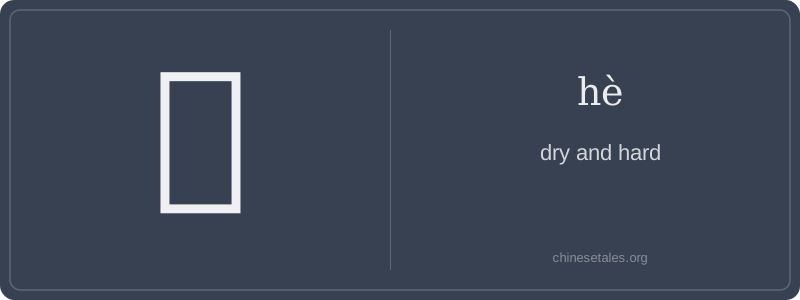
The earliest form of 垎 appears in late Warring States bamboo slips as a compound pictograph: the left side was 土 (tǔ, 'earth'), and the right side was originally an abstract glyph resembling a zigzag line with dots — possibly representing fissures radiating from a central crack. Over time, this right component evolved into the modern 可 (kě) shape through clerical script simplification, though it bears no semantic relation to 可 (‘can’); it’s purely phonetic (both 垎 and 可 share the *-e* rhyme in Old Chinese). The radical remained 土, anchoring its meaning firmly in the land — not water, not air, but earth transformed by absence.
This character’s meaning stayed remarkably stable across 2,300 years: from early medical texts describing 'hè pulse' (a taut, wiry pulse indicating internal dryness) to Du Fu’s 'hè yuán' (dry garden) imagery, 垎 always implied *dryness so extreme it induced rigidity*. Unlike characters that shifted meaning (e.g., 走 once meant 'run'), 垎 deepened its specificity — becoming narrower, not broader. Its visual austerity — simple, angular, grounded — mirrors its semantic austerity: no moisture, no give, no ambiguity.
Imagine walking across a cracked, sun-baked riverbed in northwestern China during a drought — every step crunches underfoot, the earth is parched, rigid, and unyielding. That’s 垎 (hè) in action: not just ‘dry’, but *dry to the point of hardness*, like clay that’s baked solid or soil so arid it fractures like pottery. It’s a visceral, almost tactile adjective — rare in modern speech but alive in literary description, poetry, and regional dialects (especially Shaanxi and Gansu). You’ll never hear it in daily chit-chat like ‘I’m thirsty’; instead, it paints stark, evocative scenes: a field 垎裂 (hè liè), a path 垎硬 (hè yìng).
Grammatically, 垎 functions almost exclusively as a stative adjective — it modifies nouns directly (*hè tǔ* — 'hard-dry soil') or appears in compound verbs (*hè liè* — 'crack from dryness'). It never stands alone as a predicate verb ('It is hè') without support — learners mistakenly say *tā hěn hè*, but native speakers say *tā de pí fū kū hé* (his skin is dried and cracked) or use it only in fixed collocations. It’s also tone-sensitive: mispronouncing it as *hē* (like ‘he’) or *hè* with wrong contour invites blank stares — the fourth tone must fall sharply, like a stone dropping into dust.
Culturally, 垎 carries the weight of ecological memory — it appears in Tang dynasty frontier poems describing the desolate Loess Plateau, and in modern environmental writing about desertification. Learners often confuse it with common dry-related words like 干 (gān), but 干 is neutral and versatile; 垎 is specific, severe, and poetic. It’s a fossilized word — not dead, but reserved for moments when dryness has become a physical force.