垍
Character Story & Explanation
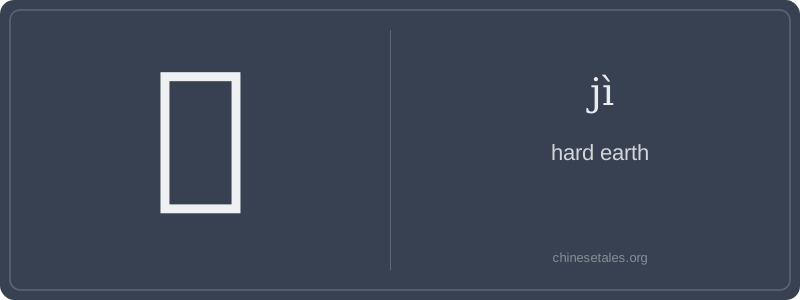
The earliest form of 垅 appears in Han dynasty bamboo slips as a compound glyph: left side '土' (tǔ, earth), right side '己' (jǐ, self — but here acting phonetically). Unlike oracle bone characters, it wasn’t pictographic — it was a phono-semantic compound born from bureaucratic land surveys. The '土' radical grounds it literally in earth; the '己' component, though now pronounced jì, originally approximated an older regional pronunciation meaning 'firm' or 'set'. Over centuries, the '己' subtly morphed — its hook sharpened, its curve tightened — until by the Song dynasty, it stabilized into today’s sleek, angular right-hand side.
This character never appeared in the *Shuōwén Jiězì* (121 CE), proving it emerged later — likely during the Northern Wei dynasty’s massive land redistribution campaigns, when officials needed precise terms for arable vs. compacted soils. Classical references are sparse, but the *Qímín Yàoshù* (535 CE, 'Essential Techniques for the Common People') uses 垅 twice — once describing 'fields where 垅 resists hoeing', another noting 'rain pools on 垅 but sinks in sandy soil'. Visually, the tight fusion of '土' and '己' mirrors its meaning: earth so compressed it becomes self-contained, almost autonomous — no longer yielding, but holding its own shape against wind and water.
Imagine you’re hiking in the Loess Plateau of northwestern China, boots crunching on sun-baked ground that cracks like ancient pottery — not soft soil, not gravel, but something denser, drier, almost ceramic. That’s 垍 (jì): not just 'earth', but *hard-packed, unyielding earth* — the kind that resists plows, holds its shape after rain, and echoes underfoot like stone. It’s a poetic, literary term, rarely heard in daily speech, carrying a tactile weight: think 'clay-hard', 'sun-fused', or 'wind-scoured'. You won’t find it on menus or subway signs — it lives in classical poetry, agrarian texts, and dialectal descriptions of terrain.
Grammatically, 垍 functions as a noun (e.g., 垅堐与垙垅 — ridges and hard-earth fields) or occasionally as an attributive adjective (e.g., 垅土 — 'hard-earth soil'). It never stands alone as a verb or modifier like 土 or 泥; it’s always contextually anchored — often paired with words like 垄, 垸, or 垆 to evoke specific landforms. Learners mistakenly treat it like a generic synonym for 'soil' — but using 垅 where 土 fits will sound archaic or jarringly technical, like saying 'argillaceous substrate' instead of 'dirt' at a garden center.
Culturally, 垅 reflects pre-modern Chinese precision in land classification — distinguishing not just soil type, but *mechanical behavior*: how it compacts, fractures, drains. Its rarity today makes it a linguistic fossil — preserved in regional gazetteers and Tang dynasty farming manuals, but nearly extinct in spoken Mandarin. Mistake it for 垦 (kěn, 'to reclaim land') or 城 (chéng, 'city'), and you’ll conjure images of bulldozers or city walls instead of cracked, golden loess.