垌
Character Story & Explanation
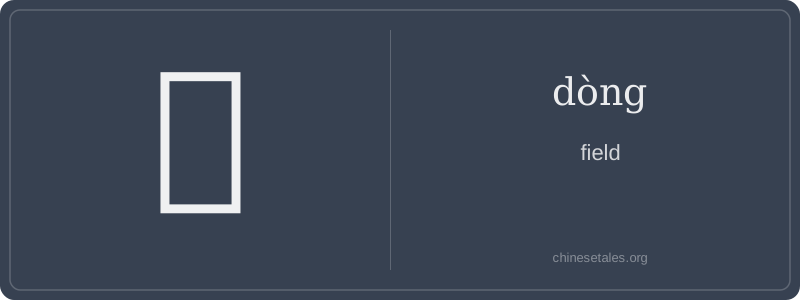
Oracle bone and bronze inscriptions don’t show 垌—it didn’t exist yet. But its components tell the tale: the left radical 土 (tǔ, 'earth') anchors it firmly in the physical world, while the right side 同 (tóng, 'same, together') wasn’t originally phonetic—it evolved from an ancient pictograph resembling a walled enclosure with a central marker, suggesting a defined, shared plot. Over centuries, seal script simplified the enclosure into 同’s shape, and clerical script standardized the nine-stroke form we see today: three horizontal earth lines at the bottom, a vertical boundary stroke, and the ‘together’ frame wrapping around.
This visual logic shaped its meaning: a bounded, communal piece of earth—literally 'earth that belongs together'. By the Tang and Song dynasties, 垌 appeared in regional land surveys and poetry from Lingnan, always specifying plots cultivated collectively or inherited by lineage. Unlike 田 (which evokes grid-like, imperial-standardized fields), 垌 whispers of terraced hillsides, riverbank plots, and family-owned patches where boundaries were marked by stones or roots—not surveyor’s ropes. Its persistence in toponyms like 'Shāndòng Village' proves how deeply this idea of intimate, named earth is rooted in southern soil.
Think of 垌 (dòng) not as a generic 'field' like the common 田 (tián), but as a specific, grounded patch of farmland—often small, enclosed, and intimately tied to family or village life. Its core feeling is earthy, local, and practical: you’d use it when describing the exact plot your uncle tills near the bamboo grove, not the abstract idea of agriculture. It’s almost never used alone in modern Mandarin; instead, it appears almost exclusively in compound words (like 菜垌 or 稻垌) or regional place names across Guangdong, Guangxi, and Hainan—especially in Cantonese and Hakka speech.
Grammatically, 垌 functions as a noun suffix or classifier-like element for cultivated land, much like how 苗 (miáo) specifies 'seedling' or 塘 (táng) means 'pond'. You won’t say *'dòng yǒu sān gè'* ('there are three dong'), but rather *'zhè ge cài dòng hěn féi'* ('this vegetable field is very fertile'). Learners often mistakenly substitute it for 田 (tián) or 地 (dì), but doing so strips away the nuance of bounded, worked soil—and may even sound oddly poetic or archaic in standard Mandarin.
Culturally, 垌 carries the quiet weight of southern Chinese agrarian identity: it’s the kind of word passed down orally in village registers, ancestral land deeds, and folk songs about harvests. Because it’s absent from HSK and rarely taught, many learners encounter it first on rural signposts or family genealogies—and then wonder why their dictionary app gives no definition. The trap? Assuming it’s just a fancy synonym for 'field'. In truth, it’s a linguistic fossil preserving how people once named their very own piece of earth—by shape, slope, and sweat.