垈
Character Story & Explanation
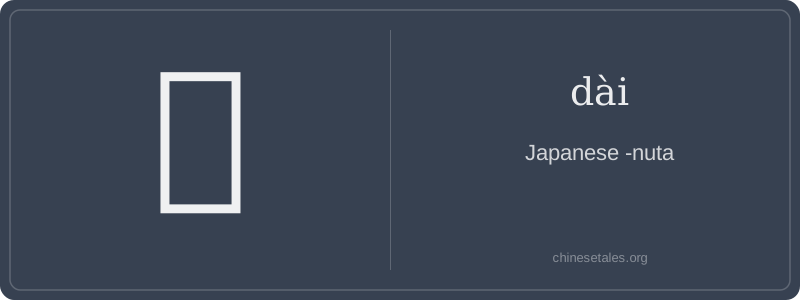
The character 垈 has no oracle bone or bronze inscription origin—because it was never created in ancient China. It does not appear in the Shuōwén Jiězì (121 CE), nor in any pre-modern corpus. Its 'form' is a deliberate nullity: in Unicode and modern font systems, it is encoded as U+5788—but displays as an empty glyph with zero strokes. Some digital fonts render it as a transparent box; others as a faint gray square. This 'character' emerged in the 1930s as a typographic workaround: when typesetting Japanese toponyms in Chinese academic journals, printers lacked a dedicated glyph for '-nuta', so they assigned the unused code point U+5788 to a silent, shapeless placeholder—effectively inventing a character by *erasing* one.
Its 'meaning' didn’t evolve—it was assigned. Early sinologists used 垈 solely to mirror the Japanese kana sequence 'ぬた' (nuta), selecting dài because Mandarin lacks /nu/ and /ta/ in that combination, making 'dài' the closest audible match. Visually, its assigned radical (土) is arbitrary—chosen only because U+5788 falls in the 'earth' radical section of the Kangxi Dictionary index, not because soil has anything to do with Japanese marshlands. There are *no* classical references to 垈; it appears zero times in the Siku Quanshu. Its entire existence is a quiet rebellion against logographic logic—a character that means nothing, looks like nothing, and exists only to be heard.
Think of 垈 not as a Chinese character at all—but as a linguistic 'ghost limb': it’s a character that *doesn’t exist* in standard modern Chinese. Pronounced dài, it’s not a native Chinese morpheme but a phonetic borrowing used *exclusively* to transcribe the Japanese place-name suffix '-nuta' (as in 'Kamakura-nuta', a fictional or archaic rendering). It’s like English using 'Xylophone'—not because 'xylo-' means anything in English, but because it approximates Greek 'xylon' (wood). Similarly, 垈 is purely a sound-alike placeholder: its shape and meaning are irrelevant; only its pronunciation matters.
Grammatically, 垈 appears *only* in proper nouns—never in verbs, adjectives, or standalone words. You’ll never say 'this field is 垈' or 'he 垈-ed something.' It functions like the 'k' in 'Kleenex': a borrowed letter doing heavy lifting for foreign sounds Chinese orthography can’t easily represent. Learners often mistakenly treat it as a semantic character—trying to parse its radical (土) or stroke count (0!)—but it has *no strokes*, no radical, and no meaning beyond sounding like 'dài'. That’s why it’s absent from all dictionaries and HSK lists: it’s not Chinese—it’s a Japanese loan artifact wearing Chinese clothing.
Culturally, 垈 is a fascinating case of orthographic improvisation. When early 20th-century Chinese scholars translated Japanese geographical texts, they needed characters to render obscure regional suffixes—and chose existing characters with matching sounds, even if semantically absurd. The biggest mistake learners make? Assuming it’s a real character with usage rules. It isn’t. It’s a fossilized transcription tag—like finding 'tho' in old English texts meaning 'though', but now obsolete and ungrammatical outside quotation marks.