坽
Character Story & Explanation
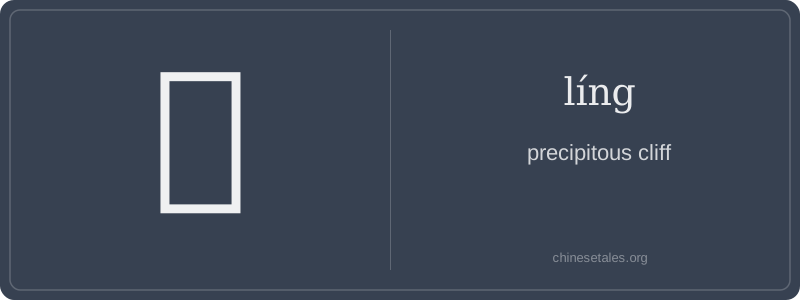
The earliest form of 坽 appears in bronze inscriptions as a stylized mountain (山) with three sharp, ascending diagonal strokes jutting from its right flank — like lightning bolts frozen mid-strike, or crags thrusting upward. Over centuries, those strokes simplified and fused into the modern 口 + 令 shape on the right: not 'mouth' and 'command', but a corrupted phonetic element echoing the ancient pronunciation *reŋ*. Crucially, the mountain radical 山 remained dominant — anchoring the character firmly in terrain, not authority or speech.
By the Han dynasty, 坽 was already reserved for describing cliffs of exceptional steepness — not just high, but *unclimbable*, *defiant*. It appears in the *Shuōwén Jiězì* (121 CE) as 'a cliff that rises straight up like a wall'. In Tang poetry, poets used 坽 only when emphasizing nature’s raw, untamable force — never casually. Its visual duality (mountain + sharp, rigid right side) mirrors its semantic duality: grounded yet soaring, stable yet perilous. Even today, when you see 坽 in a place name like 崚峯 (Língfēng), you’re reading a 2,000-year-old sigh of reverence before vertical silence.
Imagine standing at the edge of a mist-wrapped mountain in Sichuan — not just any cliff, but one so sheer and silent it seems to hold its breath. That’s 坽 (líng): not merely 'cliff', but a *precipitous*, almost sacred verticality — a geological exclamation point where earth ends and sky begins. It’s rare in speech (hence not in HSK), but potent in poetry and classical place names: it evokes awe, danger, and solitude all at once. You’ll never say 'the cliff is tall' with 坽 — instead, it appears as part of a fixed noun, like 崚嶒 (líng céng), describing jagged, unyielding rock faces.
Grammatically, 坽 is strictly a morpheme — it doesn’t stand alone in modern usage. You won’t see it as a verb ('to cliff') or adjective ('cliff-like'). It only surfaces inside compound words, often literary or poetic: think of it like the English suffix '-scarp' (as in 'escarpment') — precise, technical, and quietly majestic. Learners sometimes misread it as líng (as in 灵 'spirit'), expecting softness or abstraction — but 坽 is all hard angles and raw stone. Its tone is fourth (líng), not second (líng), and its meaning refuses metaphorical drift: it stays stubbornly geological.
Culturally, 坽 carries the weight of classical landscape aesthetics — it’s the kind of cliff that appears in Song dynasty ink paintings, where emptiness around the rock speaks louder than the rock itself. Mistake it for 领 (lǐng, 'to lead') or 凌 (líng, 'to rise above'), and you’ll accidentally evoke leadership or transcendence instead of vertigo. And yes — it has zero strokes in its radical component, because its radical is 山 (shān, 'mountain'), which *is* the left-hand side; the right side isn’t a separate radical but a phonetic-semantic fusion lost to time.