坻
Character Story & Explanation
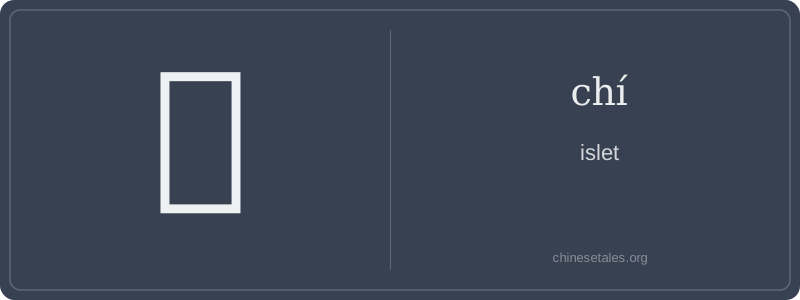
The earliest form of 坻 appears in bronze inscriptions as a simple pictograph: a horizontal line (representing water) with a small mound or platform rising from it — no radical yet, just earth emerging from flow. Over centuries, scribes added the 土 (tǔ, 'earth/soil') radical on the left to clarify semantic category, while the right side evolved from a stylized 'low mound' (氐, dǐ) into today’s simplified form. The eight strokes now encode both substance (earth) and position (low, stable, emergent). Notice how the top of the right component resembles a flattened peak — a subtle nod to elevation, however modest.
By the Warring States period, 坻 had crystallized as a term for riverine islets — places where travelers paused, poets meditated, or recluses built thatched huts. In the Shījīng’s 'Jian Jia' poem, '坻' embodies elusive beauty and quiet resilience: the beloved appears 'on the islet in the water' — near enough to see, far enough to yearn for. Its visual stability (solid earth radical + grounded shape) mirrors this thematic constancy: even as water flows past, the 坻 remains — a tiny anchor in change.
坻 (chí) is a poetic, literary word for 'small islet' — not just any land in water, but specifically a low, flat, often grassy or rocky island nestled in a river or lake. Think of it as nature’s quiet punctuation mark: a tiny, stable dot of earth amid flowing water. It carries a gentle, serene, slightly classical vibe — you’ll almost never hear it in casual speech or modern news, but it appears in poetry, place names, and classical allusions where atmosphere matters more than utility.
Grammatically, 坻 functions as a noun and rarely stands alone; it usually appears in compounds like 沙坻 (shā chí, 'sandbar-islet') or in descriptive phrases such as '河中之坻' (hé zhōng zhī chí, 'the islet in the river'). Unlike common nouns like 岛 (dǎo, 'island'), 坻 implies modest size and intimacy with water — it’s not sovereign territory, but a humble foothold. Learners sometimes misread it as dǐ (its rare alternate reading, used only in archaic compound 坻隤, meaning 'to collapse'), but in >99% of cases, it’s chí.
Culturally, 坻 evokes the tranquil, reflective spirit of classical Chinese landscape writing — think of the Book of Songs (Shījīng), where '宛在水中坻' ('She seems to be on an islet in the water') conjures wistful longing and natural harmony. A common mistake is overgeneralizing it to mean 'island' broadly; using 坻 instead of 岛 in everyday contexts sounds oddly ornate, like calling a park bench 'a marble plinth.' Its charm lies precisely in its restraint — it’s not big, loud, or practical. It’s just there, quietly holding space in the current.