坴
Character Story & Explanation
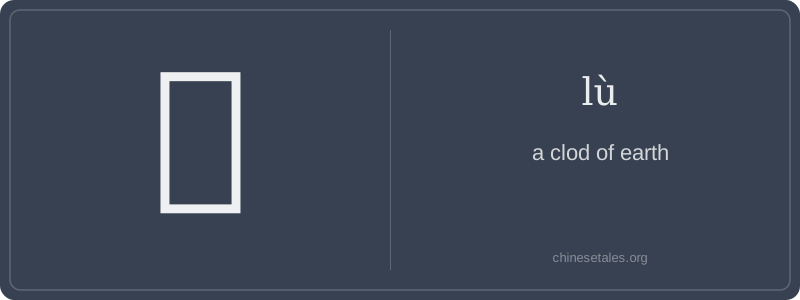
The earliest form of 坴 appears in seal script (not oracle bone), where it clearly combines 土 (tǔ, 'earth', the radical at the bottom) with 田 (tián, 'field', top component) — but crucially, 田 here isn’t meant as 'field' semantically. Instead, it’s a stylized depiction of a *clod*: the four lines represent cracks forming a square-shaped lump rising from the ground. Over time, 田 simplified into the current top — two horizontal strokes and two verticals — while 土 retained its three-stroke form (one horizontal, one dot, one long horizontal base). The eight strokes encode this layered image: earth below, structured clod above.
This visual logic held steady through the Han dynasty: in texts like the Shuōwén Jiězì, 坴 is defined as 'a lump of earth that can be held in the hand' (手可握之土). By the Tang, poets used it for symbolic contrast — e.g., Du Fu’s line 'the clod remains silent while the river rushes' (坴默而川流), highlighting earth’s stoic stillness against time’s flow. Even today, its shape whispers 'earth made manifest': not abstract soil, but something you can lift, weigh, and place — a miniature landscape in your palm.
Imagine a farmer in northern China, kneeling in dry loess soil after spring plowing — his calloused hands scoop up a dense, crumbly lump of earth: not dust, not mud, but a solid, palm-sized lù, a clod that holds its shape when lifted. That’s 坴 — not just 'dirt', but a tangible, weighty, self-contained unit of earth with texture and integrity. It evokes dryness, compactness, and rural authenticity. You’ll almost never see it in daily conversation; it’s literary, poetic, or technical — think agronomy texts or classical poetry describing cracked fields.
Grammatically, 坴 is a noun only — no verb forms, no adjectival use. It rarely stands alone: you’ll encounter it in compounds like 坴块 (lù kuài, 'clod') or as part of descriptive phrases: 'a 坴 of yellow earth' (一坴黄土). Learners mistakenly try to use it like 土 (tǔ, 'soil' or 'earth' generically), but 坴 is specific — if you say 'this soil is fertile', you say 这片土很肥沃, never 这片坴很肥沃. It’s countable and concrete: 三坴干土 ('three clods of dry earth'), not *一坴土壤.
Culturally, 坴 carries quiet dignity — it appears in mourning contexts (e.g., 坴土, 'clod of native soil', carried by exiles) and ecological writing about soil erosion. A common mistake? Confusing it with 禄 (lù, 'salary' or 'blessing') — same sound, utterly unrelated meaning and origin. Also, don’t confuse its radical 土 (earth) with the similar-looking but unrelated 石 (shí, 'stone') — 坴 is always about earth, never rock or mineral.