坳
Character Story & Explanation
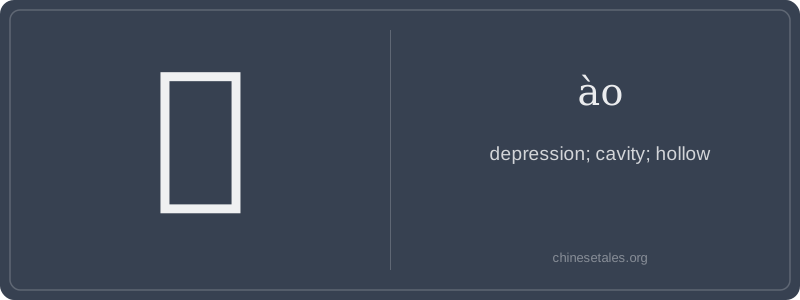
The earliest form of 坳 appears in seal script, evolving from a combination of 土 (tǔ, earth/soil) on the left and 幼 (yòu, young/small) on the right — not as a semantic-phonetic pair at first, but as a visual metaphor: a small, sunken area *in the earth*. The original bronze inscriptions show 土 with two short horizontal strokes curving inward below, suggesting concavity — like a shallow bowl pressed into soil. Over time, the right side simplified from 幼 (itself composed of + 力) into the modern 幺 (yāo, tiny thread), preserving the idea of something small and nestled.
This visual logic held firm across dynasties: in the *Shuōwén Jiězì* (121 CE), Xu Shen defined 坳 as ‘a low place between hills’, confirming its topographic core. Classical poets like Wang Wei used 山坳 to evoke seclusion and stillness — ‘the temple door opens only after passing deep into the mountain hollow’. The character’s enduring power lies in how its shape mirrors its meaning: the 土 radical grounds it literally in earth, while the compact, inward-curving right side visually ‘cups’ space — a rare case where stroke flow mimics physical containment.
Imagine hiking through mist-shrouded hills in southern China — bamboo swaying, damp earth underfoot — when suddenly the path dips into a quiet, sheltered hollow surrounded by low ridges. That’s an ào: not just any dip, but a natural, bowl-like depression in the land, often sheltered, sometimes holding water after rain, always subtly secluded. In Chinese, 坳 carries a gentle, earthy weight — it’s poetic and regional, evoking rural landscapes, not urban topography. You’ll rarely hear it in daily conversation (hence its absence from HSK), but it appears in literature, place names, and dialect speech to convey intimacy with terrain.
Grammatically, 坊 is a noun that almost always appears in compound nouns or place names — you won’t say *‘I found an ào’* as a standalone sentence. Instead, it’s embedded: 山坳 (shān ào, mountain hollow), 村坳 (cūn ào, village hollow), or in verbs like ‘绕过山坳’ (rào guò shān ào, ‘to circle around the mountain hollow’). Learners mistakenly treat it like a general word for ‘valley’ — but valleys (谷 gǔ) are larger and more open; 坳 is smaller, cozier, and always *enclosed* by higher ground.
Culturally, 坳 hints at how intimately Chinese geography shapes language: this character doesn’t just describe space — it implies shelter, concealment, even secrecy. Old folk tales set ‘in the deep mountain hollow’ often involve hidden temples or reclusive sages. A common error? Confusing it with 奥 (ào, profound/mysterious) — same pinyin, totally different meaning and radical. Pronouncing 坳 as ‘ào’ feels like whispering — fitting, since hollows muffle sound.