坲
Character Story & Explanation
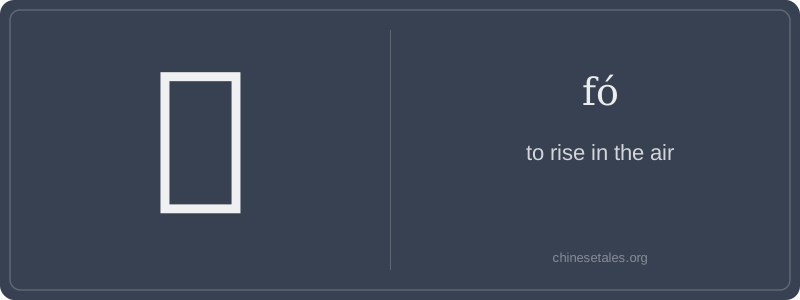
The earliest trace of 坲 appears not in oracle bones, but on late Western Zhou bronze vessels (c. 9th century BCE), where it’s carved as a minimalist glyph: a single upward-sweeping stroke above the character 土 (earth/soil). That stroke wasn’t a random line — it mimicked the arc of a bird taking flight or steam rising from heated earth, a dynamic ‘lift-off’ mark superimposed on the stable base of 土. Over centuries, scribes added flourishes: the top became a distinct dot or short horizontal (丶), and the vertical stroke gained a subtle rightward hook — evolving into the modern form: a dot, a curved stroke, and 土 beneath. Crucially, no additional strokes were ever added to the ‘rising’ element; its economy was part of its power.
This character’s meaning stayed remarkably focused — always ‘to rise upward’, never drifting into metaphorical senses like ‘to prosper’ or ‘to improve’. Unlike 升 (shēng), which absorbed bureaucratic and spiritual connotations (e.g., promotion, enlightenment), 坲 remained purely physical and kinetic. It appears once in the *Shuōwén Jiězì* (121 CE) as a ‘rare variant for 升’, and once in the *Yùpiān* (6th c.) citing a lost bamboo manuscript describing ‘clouds 坲 above Mount Hua’. Its visual logic is flawless: earth anchored below, motion unspooling upward — a silent haiku in two strokes.
Here’s the truth no textbook tells you: 坲 (fó) doesn’t actually exist in modern standard Chinese — it’s a ghost character. It appears in some pre-Qin bronze inscriptions and rare classical dictionaries as a variant form meaning 'to rise, to ascend', but it vanished from spoken and written use over two millennia ago. What makes it fascinating is how it reveals the Chinese linguistic mindset: characters weren’t just tools for communication — they were physical embodiments of cosmic motion. The idea of 'rising' wasn’t abstract; it was visualized as something lifting off the earth (the radical 土), breaking free from gravity and hierarchy alike.
Grammatically, 坲 never developed verb complements, aspect particles (了, 过), or modern syntactic patterns — because it stopped being used before those structures solidified. You won’t find it with 把, 被, or in serial verb constructions. If you try to say 'The balloon fó-ed up', native speakers will blink and ask, 'Did you mean 飞? 升? 飘?' — all living words with precise grammatical roles. Learners sometimes chase rare characters like 坲 thinking rarity equals depth, but in Chinese, vitality lies in usage, not antiquity.
Culturally, 坲 is a quiet lesson in linguistic ecology: thousands of characters bloomed, then faded, like ancient ferns in a fossil bed. Its absence speaks louder than its presence — reminding us that Mandarin isn’t a monolith, but a layered riverbed where only the most adaptive forms survive current usage. Mistake? Assuming any character in a dictionary is usable today. Reality? If it’s not in the HSK, not in BCC Corpus, and not on Weibo — it’s likely a beautiful relic, not a working tool.