坱
Character Story & Explanation
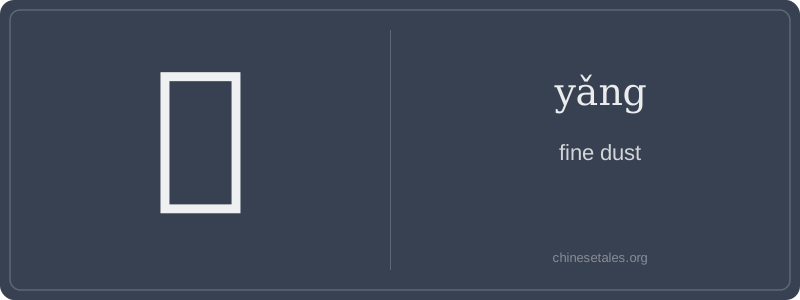
The earliest attested form of 坱 appears in Han dynasty seal script, not oracle bone — it’s relatively late. Its structure is deceptively simple: left side 土 (tǔ, ‘earth’), right side 央 (yāng, ‘center’, ‘core’). But look closer: 央 was originally a pictograph of a person with arms outstretched, centered within a boundary — later stylized into today’s shape. In 坱, 央 isn’t phonetic alone; it subtly conveys *centrality* and *dispersion* — the fine particles radiating outward from a focal point, like dust motes caught in a sunbeam’s core.
By the Six Dynasties period, 坱 appears in texts like the *Shuowen Jiezi* commentary as a variant for describing ‘microscopic earth-suspended matter’. It gained literary traction in Tang poetry — Li Bai used 坱埃 (yǎng āi) to contrast coarse reality (埃) with ethereal dust (坱), suggesting layers of perception. The character’s visual duality — grounded by 土 yet lifted by the open, central space implied by 央 — mirrors its semantic tension: earth-bound yet airborne, material yet elusive. This isn’t just dust — it’s dust *as atmosphere*.
Imagine walking barefoot through an ancient, sun-drenched courtyard after a dry summer — not the coarse gravel under your toes, but that faint, almost invisible haze clinging to the air and settling on every surface: the silent, weightless cloud of fine dust that catches the light like suspended gold. That’s 坱 (yǎng) — not dirt, not soil, not ash, but *fine dust*: the kind that floats, lingers, and resists sweeping. It’s poetic, delicate, and highly specific — you’d never use it for dust bunnies or construction debris.
Grammatically, 坱 is almost always found in classical or literary compounds (like 塵坱 or 坱埃), rarely as a standalone word in modern speech. You won’t hear it in daily conversation — no one says ‘I need to vacuum the 坱!’ — but it appears in refined descriptions: ‘a room thick with 坱’ evokes quiet decay; ‘sweeping away 坱’ suggests spiritual purification. Learners often mistakenly treat it as a synonym for 尘 (chén, ‘dust’), but 坱 is narrower — always *finely dispersed*, never granular or heavy. Using it where 尘 fits breaks register: it sounds archaic or deliberately ornate.
Culturally, 坱 carries a subtle Daoist-Buddhist resonance — symbolizing the impermanent, insubstantial nature of worldly things. In Tang poetry, it’s paired with mist, wind, or emptiness to evoke transience. A common pitfall? Assuming its radical (土) means it’s about earth — but here 土 isn’t literal ground; it’s the *medium* through which fineness manifests: dust arises *from* earth yet escapes its weight. So while 尘 = dust as substance, 坱 = dust as phenomenon — airy, evanescent, almost metaphysical.