坰
Character Story & Explanation
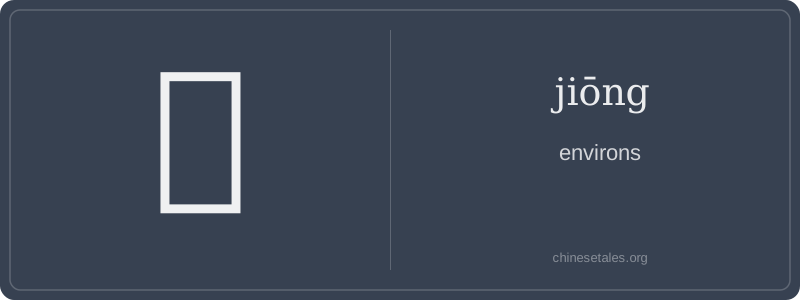
Oracle bone inscriptions show 坰 as two distinct elements: an outer enclosure (冂, 'wide open gateway') cradling a simplified pictograph of land with scattered vegetation — possibly a stylized 'field' (田) or 'grass' (艸) inside. Over centuries, the inner element evolved into 夋 (a variant of 君, used here phonetically), while the outer frame solidified into 冂 — preserving the core idea of 'bounded open space'. By the seal script era, the shape stabilized: 冂 (enclosure) + 夋 (sound and subtle suggestion of 'dignified openness'), making it a phono-semantic compound.
This visual logic shaped its meaning: not wilderness, but the *civilized edge* — land near settlement, neither tamed nor wild. In the Classic of Poetry (Shījīng), 坰 appears in lines describing hermits wandering 'beyond the village bounds', reinforcing its association with quiet retreat. Later, Tang poets like Wang Wei used 郊坰 to evoke serene distance from court life — always with reverence, never neglect. Its form — a frame holding space — mirrors its function: defining the gentle threshold between human order and natural grace.
坰 (jiōng) is a poetic, literary word meaning 'environs' — specifically the open, uncultivated land just beyond the village boundary: fields, meadows, or fallow ground where human settlement thins and nature begins. It’s not 'suburb' (郊区) nor 'countryside' (乡村) — it’s that liminal, quiet fringe, carrying a gentle pastoral weight, like the hush between a village gate and the first wild grasses. You’ll almost never hear it in daily speech; it lives in classical poetry, historical texts, and formal writing.
Grammatically, 坰 functions only as a noun and appears almost exclusively in compounds (like 郊坰 or 林坰), rarely alone. Unlike common nouns such as 地 (dì, 'ground') or 区 (qū, 'area'), 坰 cannot take measure words (no 一个坰, no 这坰); it resists modern syntactic patterns. Learners sometimes try to use it like 郊区 ('suburb'), but that’s a red flag — 坰 evokes solitude and antiquity, not commuting routes or shopping malls.
Culturally, 坰 reflects ancient Chinese spatial thinking: the ordered human world (inside the walls) versus the untamed yet benign periphery (outside). Mistaking it for 疆 (jiāng, 'borderland' — militarized, political) or 境 (jìng, 'realm' — abstract, often philosophical) is common. The character’s rarity means even advanced learners may misread its tone (it’s jiōng, *not* jiǒng or jiòng) — and yes, that ‘ō’ vowel matters: it’s the long, open sound of wide-open space.