坪
Character Story & Explanation
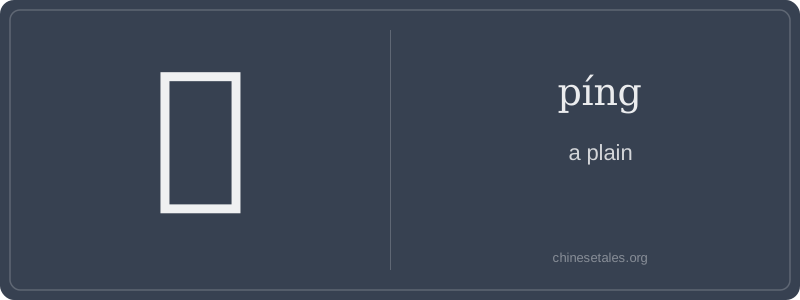
The earliest form of 坪 appears in seal script, not oracle bone — it’s relatively young, emerging around the Warring States period. Visually, it’s a clear fusion: the left side is 土 (tǔ), unmistakably 'earth', drawn with three horizontal strokes representing layers of soil. The right side is 平 (píng), which itself evolved from a pictograph of a scale beam held level — two equal weights, balanced and still. When combined, the character visually declares 'earth made level', like smoothing soil with a wooden board before planting rice or laying flagstones.
Over time, 坪 shed its abstract balance imagery and settled into concrete, lived-in meaning. In classical texts like the *Book of Songs*, related terms appear in agricultural odes praising well-tilled fields, though 坪 itself became common later — especially in regional dialects of Fujian and Guangdong, where hilly terrain made terraced, leveled plots essential. Its enduring power lies in that visual marriage: 土 + 平 = land that has been thoughtfully, patiently, humanly flattened — not by nature, but by care.
Think of 坪 (píng) as China’s quiet, grounded answer to 'plain' — but not the vast, windswept kind you imagine in Kansas. It’s a small, flat, human-scaled expanse: a grassy terrace carved into a hillside, a leveled courtyard behind a village house, or even a tidy urban park patch. The 土 radical at the left anchors it firmly in earth — literally 'soil' — while the right side 平 (píng, 'flat, level') isn’t just phonetic; it’s semantic glue. This is a rare case where the sound component *also* tells you the meaning — like getting two gifts in one envelope.
Grammatically, 坪 behaves like a noun, often appearing in compound words rather than alone — you won’t hear someone say 'Look at that 坪!' in daily speech. Instead, it shows up in place names (like 深圳坪山 Shēnzhèn Píngshān), land measurements (1 坪 ≈ 3.3 m² in Taiwan), and poetic or regional descriptions of terrain. Learners sometimes misread it as 平 or try to use it like 平原 (píngyuán, 'great plain'), but 坪 is intimate, domestic, and local — never grand or geographical.
Culturally, 坪 carries the quiet dignity of cultivated land — not wilderness, but soil made useful and harmonious through human care. In southern China and Taiwan, it’s still used in real estate and farming contexts, evoking stability and livability. A common mistake? Overgeneralizing it as 'plain' in translations — which flattens its nuance. Remember: 坪 is less about geography, more about intentionality — earth deliberately made level and shared.