坨
Character Story & Explanation
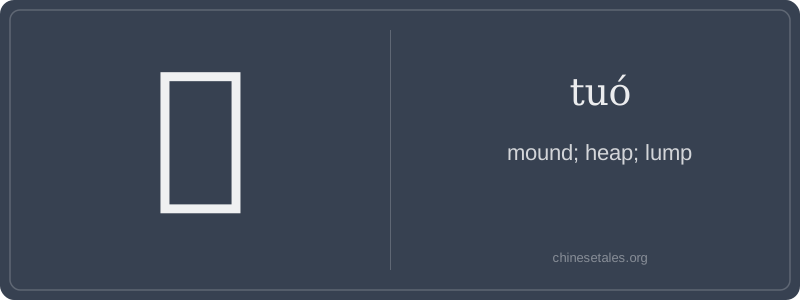
The earliest form of 坨 appears in seal script as a compound: the radical 土 (tǔ, 'earth') on the left, paired with 它 (tā, originally a pictograph of a snake — but here acting phonetically). In bronze inscriptions, the right side wasn’t yet standardized; scribes carved it loosely — sometimes with a curved tail-like stroke to suggest roundness and mass. Over centuries, the snake glyph simplified into the modern 陀, but crucially, the ‘earth’ radical stayed put on the left, anchoring the meaning firmly in the ground. By the Han dynasty, the shape had settled into its current eight-stroke form: 土 + 陀 — visually grounding sound and sense together.
This character didn’t begin as abstract — it emerged from farmers observing how soil clumped after rain, or how frost heaved earth into small, rounded hillocks. In the Shuōwén Jiězì (121 CE), Xu Shen defined it as 'a small hill; a rounded heap', linking it to terrain features too modest for 大山 (dàshān, 'great mountain') or 丘 (qiū, 'elevated mound'). Later, poets like Du Fu used it subtly — not as scenery, but as texture: 'the mud formed cold tuó under the eaves' — where 坨 quietly conveyed weight, chill, and quiet accumulation. Its visual roundness (note the curve in 陀!) mirrors its semantic softness — no sharp peaks, only gentle, earth-bound bulges.
Think of 坨 not as a fancy literary word, but as a tactile, earthy little character — it’s the Chinese word for a small, natural lump or mound: a hump in the ground, a clod of dirt, a soft heap of snow or sand. It carries a quiet, grounded weight — never sharp or angular, always gently rounded and physical. You won’t find it on HSK lists because it’s more poetic than practical, popping up in descriptive writing, classical allusions, or regional dialects rather than daily chit-chat.
Grammatically, 坨 is almost always a noun (rarely used alone — usually in compounds like 土坨 or 雪坨), and it often appears after measure words like 一坨 (yī tuó), which literally means 'one lump'. Yes — just like English uses 'a lump of clay' or 'a chunk of cheese', Chinese says 一坨泥 (yī tuó ní) — and yes, that same measure word can jokingly describe a messy pile of paperwork or even an awkward silence ('一坨尴尬'). Watch out: learners sometimes misread it as tuō or tà — but it’s always tuó, with that soft, rolling second tone.
Culturally, 坨 evokes rural China: the lumpy texture of freshly turned soil, the way snow gathers in uneven mounds after a windless night, or how dough swells into soft, irregular blobs before baking. It’s humble, unrefined, and deeply sensory — so much so that in northern dialects, saying 一坨人 (yī tuó rén) isn’t rude, just vividly colloquial: 'a jumble of people', shoulder-to-shoulder and indistinct. Don’t force it into formal essays — but do savor it when you read Lu Xun’s descriptions of frozen northern fields or modern poets writing about eroded hillsides.