圱
Character Story & Explanation
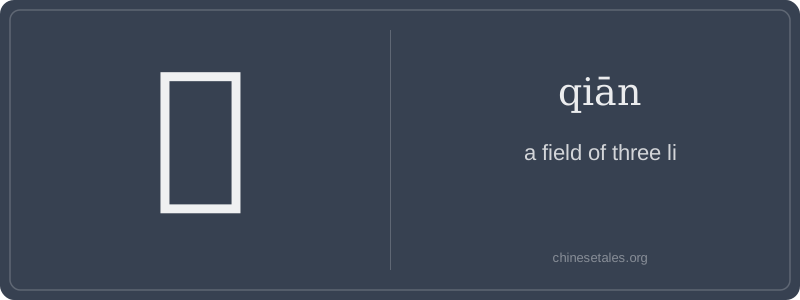
The earliest form of 圱 appears on Western Zhou bronze inscriptions as a composite glyph: a simplified 田 (field) crossed by three parallel horizontal strokes — not decorative lines, but deliberate tally marks for ‘three li.’ Over centuries, the 田 base stabilized, while the three strokes fused into the top component resembling 干 (gān), though it’s etymologically unrelated. By the Han dynasty clerical script, the shape hardened into today’s structure: 干 over 田 — a visual contract between measurement and land, carved not with ink but with bronze chisels and tax ledgers.
This character didn’t evolve — it ossified. Unlike most Chinese characters that broadened or shifted meaning (e.g., 走 once meant ‘run’), 圱 held its ground: in the Rites of Zhou (Zhou Li), it appears in passages mandating that ‘one 圱 of land supports one household,’ defining feudal obligation down to the li. Its visual rigidity mirrors its semantic immobility: no poetry, no idioms, no slang — just three li, squared, unchanged for 2,700 years. Even the Kangxi Dictionary (1716) lists it with a single definition and zero compound words — a monument to administrative exactitude.
Let’s cut to the chase: 圱 (qiān) isn’t a character you’ll see on subway signs or in beginner textbooks — it’s a quiet relic of ancient Chinese land measurement. Its core meaning is hyper-specific: 'a field measuring three li (≈1.5 km) square.' That’s not poetic metaphor — it’s bureaucratic precision from the Zhou dynasty, where land was surveyed and taxed by standardized units. The character feels archaic, almost ceremonial; it carries the weight of imperial granaries and bronze-inscribed cadastral records, not everyday conversation.
Grammatically, 圱 functions almost exclusively as a noun — never a verb or adjective — and appears only in classical texts, historical documents, or scholarly discussions of pre-Qin agriculture. You won’t say ‘I walked across a 圱’; you’ll read ‘the duke allocated three 圱 to the minister’ in a reconstructed bamboo-slip passage. It never takes aspect particles (了, 过) or modifiers like 很 or 非常 — its usage is frozen in time, like Latin ‘jugerum’ in English botany texts.
Culturally, learners often misread 圱 as related to modern ‘field’ characters like 田 (tián) or 地 (dì), but that’s a trap: 圱 has zero semantic overlap with farming or geography today. Its biggest pitfall? Confusing it with 千 (qiān, ‘thousand’) — identical pronunciation, wildly different meaning and origin. This isn’t a ‘vocabulary gap’ — it’s a time capsule. If you encounter it, you’re not learning Mandarin — you’re holding a shard of Warring States surveyor’s notation.