圯
Character Story & Explanation
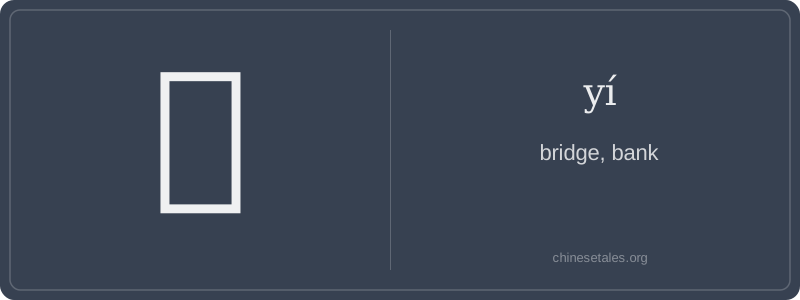
The earliest form of 圯 appears in seal script as a combination of 土 (tǔ, 'earth') on the left and 巳 (sì, originally a pictograph of a coiled serpent or bent arm) on the right — but crucially, 巳 here is not semantic; it serves phonetically (as a *shengfu*, sound component), while 土 anchors meaning. Over time, 巳 simplified into the modern 巳 shape — three horizontal strokes capped by a curved hook — preserving just enough of its ancient contour to hint at curvature, perhaps echoing the gentle arc of a riverbank. The six strokes flow deliberately: two earth dots, then the vertical earth stroke, followed by the three-stroke 巳 — a compact, balanced silhouette.
This character first appeared in the Shuōwén Jiězì (121 CE), defined as 'an earthen bridge' or 'the bank of a river'. Its most celebrated usage comes from Sima Qian’s account of Zhang Liang, who, after humbly retrieving a lost shoe for the sage Huang Shigong, was summoned to meet him 'at the eastern end of the earthen bank' — 圯上 (yí shàng). Here, 圯 isn’t merely topographical; it’s symbolic terrain — where human patience meets celestial instruction. The visual simplicity of 圯 (just earth + sound) belies its weight: it’s the quiet ground upon which pivotal moments of Chinese intellectual history literally stood.
Imagine standing on a crumbling earthen bank beside a rushing river in ancient Chu — not on a grand stone bridge, but where the soil itself forms a natural crossing or embankment. That’s 圯 (yí): it evokes not modern infrastructure, but the raw, earthy interface between land and water — a raised stretch of soil that serves as both bridge and bank. It’s poetic, archaic, and deeply tactile: you feel the grit underfoot, hear the river’s murmur, sense the quiet authority of earth holding back water.
Grammatically, 圯 is almost never used alone today — it appears only in classical compounds or literary set phrases, never in everyday speech or writing. You won’t see it in menus, apps, or news headlines. It functions as a noun, often modified by adjectives like 古 (gǔ, 'ancient') or 临 (lín, 'adjacent to'), and appears in fixed expressions like 圯上 (yí shàng, 'on the earthen bank') — always with a quiet, historical gravity. Learners sometimes mistakenly try to substitute it for 桥 (qiáo, 'bridge') or 岸 (àn, 'bank'), but 圯 carries no neutral or functional connotation; it’s inherently literary, even elegiac.
Culturally, 圯 is inseparable from the famous story of Zhang Liang receiving military strategy from Huang Shigong on a riverside earthen platform — an event immortalized in the Records of the Grand Historian. Mistaking 圯 for a generic 'bridge' misses its resonance: it’s not about crossing *over*, but about grounding *beside* — a place of humility, waiting, and revelation. Modern learners rarely encounter it outside classical texts or calligraphy — and that’s precisely why it’s fascinating: a six-stroke fossil of Chinese literary consciousness.