圮
Character Story & Explanation
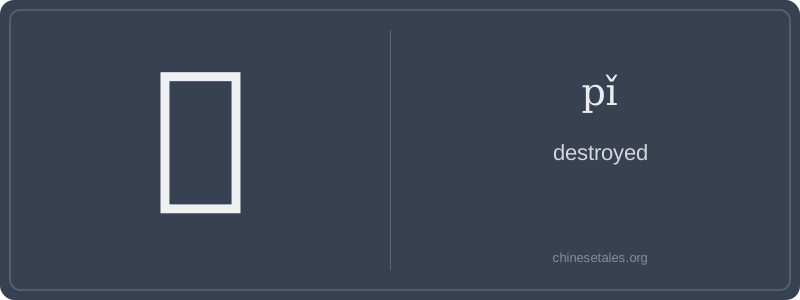
The earliest form of 圮 appears in bronze inscriptions as a combination of 土 (tǔ, 'earth/soil') and 巳 (sì, originally a pictograph of a coiled serpent or fetal form — later repurposed for sound). In oracle bone script, the right side wasn’t yet standardized as 巳; instead, it resembled a bent pillar or cracked beam leaning over soil — visually evoking a structure buckling into the earth. Over centuries, the right-hand component simplified and stylized into 巳, while the left retained its three-stroke 土 radical, grounding the character literally and semantically in the earth’s pull on failing architecture.
By the Warring States period, 圮 was already used to describe the decay of ritual spaces — Confucius lamented '宗庙圮坏' (ancestral temples collapsing) as a sign of moral decline. In the Han dynasty’s *Shuōwén Jiězì*, Xu Shen defined it as '毁也' (‘to destroy’), but specifically noted its use for 'walls, towers, and earthen fortifications falling in'. Its visual logic remains potent: 土 (foundation) + 巳 (a shape suggesting bending, yielding, exhaustion) = the moment structural integrity surrenders to gravity and time — not explosive demolition, but silent, inevitable subsidence.
At its core, 圮 (pǐ) isn’t just ‘destroyed’ — it’s the quiet, irreversible collapse of something once solid and dignified: a bridge crumbling into a river, a dynasty’s ancestral hall reduced to rubble, a promise shattered beyond repair. It carries a literary, almost elegiac weight — you won’t hear it in daily chatter like 坏了 (huài le, 'broken') or 毁了 (huǐ le, 'ruined'); instead, it appears in classical texts, historical narratives, and poetic descriptions where destruction feels fated, structural, and deeply symbolic.
Grammatically, 圮 is almost exclusively used as a verb in formal or literary contexts — never as an adjective or in casual compounds. It often appears in parallel structures (e.g., 崩圮 — bēng pǐ, 'collapse and crumble') or as the predicate in solemn declarations: '古塔已圮' (The ancient pagoda has collapsed). Crucially, it’s not transitive — you don’t 圮 something; something *is* 圮 (intransitive, perfective, often with 已 or 已经). Learners mistakenly try to say '他圮了房子' — but that’s ungrammatical and nonsensical; 圮 describes inherent, self-contained ruin, not an agent’s action.
Culturally, 圮 reflects the Chinese philosophical sensitivity to entropy — the idea that even enduring things (earthworks, stone bridges, moral orders) inevitably succumb to time and neglect. It’s the linguistic echo of the I Ching’s 'all things must decline after reaching their peak.' Because it’s absent from HSK and modern spoken Chinese, learners rarely encounter it outside classical reading — and when they do, they often misread it as pī (like 批) or confuse it with 疲 (tired), missing its visceral, architectural gravity.