圭
Character Story & Explanation
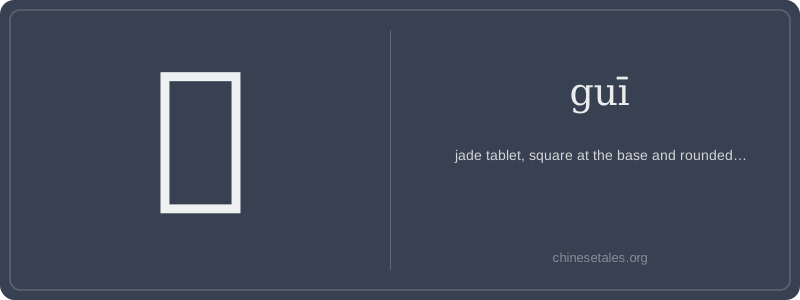
The earliest form of 圭 appears in bronze inscriptions (jinwén) as two parallel vertical lines topped by small, rounded or pointed caps — a stylized depiction of a ceremonial jade tablet held upright. Oracle bone script doesn’t preserve it clearly, but by the Western Zhou period, scribes rendered it as two matching units stacked vertically, each echoing the shape of 土 (earth) yet deliberately simplified: no bottom stroke, just two short horizontals flanking a central vertical — evoking both symmetry and sacred proportion. Over centuries, the top unit shrank slightly and tilted subtly, while the bottom grew more stable, cementing the visual impression of 'base + apex', 'earth + heaven'.
This form directly mirrored its function: in the Rites of Zhou (Zhōu Lǐ), the guī was assigned by rank — the king’s was longest and most ornate; ministers’ were shorter and simpler. Its length, thickness, and carving encoded hierarchy like a barcode. In the Book of Rites (Lǐjì), it’s described as 'the measure of trust' — presented during oaths and alliances. The character’s clean, balanced structure isn’t arbitrary; it’s calligraphy as cosmology: two equal halves representing yin-yang balance, grounded in earth (radical 土), yet pointing upward toward moral authority and celestial order.
Think of 圭 (guī) not as just 'jade tablet' but as a silent diplomat from ancient China — a slender, elegant object that spoke volumes without a word. It wasn’t jewelry or decoration; it was protocol carved in jade: square at the base (like stability, like earth), tapering to a point or curve at the top (like aspiration, like heaven). That shape is literally built into the character: two stacked 'earth' radicals (土) — wait, no! Actually, look closely: it’s two identical units (each resembling 土 but missing the bottom horizontal stroke), stacked vertically. This symmetry mirrors the ritual precision of Zhou dynasty court ceremonies — where holding the correct guī signaled your rank, loyalty, and even your right to speak before the king.
Grammatically, 圭 is almost never used alone today — it’s a fossilized noun, preserved only in compounds and classical allusions. You won’t say 'I hold a guī' in modern Mandarin; instead, you’ll meet it in words like 圭臬 (guī niè, 'standard or guiding principle') or 圭表 (guī biǎo, an ancient solar instrument). Learners sometimes try to use it like a generic 'jade' word — big mistake! It’s not 玉 (yù, jade material); it’s a specific ritual object with sacred geometry. Misusing it sounds like calling a scepter 'a fancy stick' at Buckingham Palace.
Culturally, 圭 embodies the Chinese ideal of harmony between human order and cosmic structure: its shape echoes the earth-heaven axis, and its material — nephrite jade — symbolized virtue, purity, and immortality. Even Confucius praised rulers who governed with the integrity of a perfectly cut guī. Today, the character survives mostly in literary or scholarly contexts — a whisper of ritual gravity in an age of emojis. The biggest trap? Assuming it’s easy because it’s only six strokes. Its quiet power lies precisely in its rarity and resonance.