圬
Character Story & Explanation
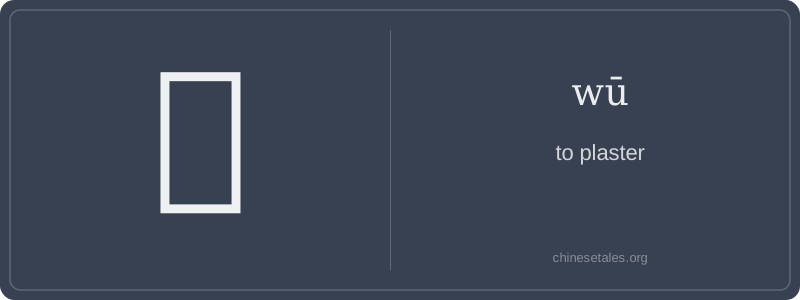
The earliest form of 圬 appears in bronze inscriptions as a pictograph combining 'earth' (土) with a simplified hand holding a flat, broad blade — imagine a forearm pressing a trowel into wet clay. Over time, the hand evolved into the top-right component 亏 (kuī), which originally depicted a bent arm and open palm, then stylized into its modern form. Meanwhile, the 'earth' radical remained anchored at the bottom left, grounding the action in material reality — no plaster floats in air. By the Small Seal Script, the six-stroke structure was fixed: 土 + 亏, with the horizontal stroke of 亏 echoing the leveling motion of a plasterer’s sweep.
This visual logic deepened in meaning: Confucius famously praised his disciple Zilu for valuing honesty over ornamental polish — saying '圬者,饰其表也' ('One who plasters decorates only the surface'). Here, 圬 became metaphorical: to conceal flaws with smoothness, even deceitfully. Yet paradoxically, in Tang dynasty architecture records, 圬 also denoted meticulous integrity — the very act of sealing cracks before painting. So this character straddles two truths: surface refinement can be either shallow artifice or profound care. Its shape holds both.
Think of 圬 (wū) as the Chinese equivalent of a trowel — not the tool itself, but the *act* of smoothing wet plaster onto a wall with deliberate, rhythmic strokes. It’s not just 'to apply' — it’s to finish, to refine, to make surface-level perfection. Unlike common verbs like 涂 (tú, 'to paint/smear') or 刷 (shuā, 'to brush'), 圬 carries a craftsman’s gravity: it implies skill, intention, and architectural finality.
Grammatically, 圬 is almost always a verb in classical or literary contexts — rarely used alone today, but frequently appears in compound verbs like 圬墁 (wū màn, 'to plaster and level') or as part of passive constructions in historical texts ('墙已圬毕', 'the wall has been fully plastered'). You’ll almost never hear it in daily spoken Mandarin; if you do, it’s likely from an artisan quoting an old building manual or a scholar reading Tang dynasty poetry about temple restoration.
Culturally, learners often mistakenly assume 圬 is interchangeable with 涂 or 抹 (mǒ), leading to awkward phrasing like '我圬了一面墙' — which sounds like you’re quoting a Song-dynasty mason rather than fixing your bathroom. The character also subtly signals hierarchy: in classical texts, only skilled laborers (not masters or officials) '圬'; their hands shape surfaces, while others shape policy. That quiet dignity — of craft as moral act — lingers in its six strokes.