圩
Character Story & Explanation
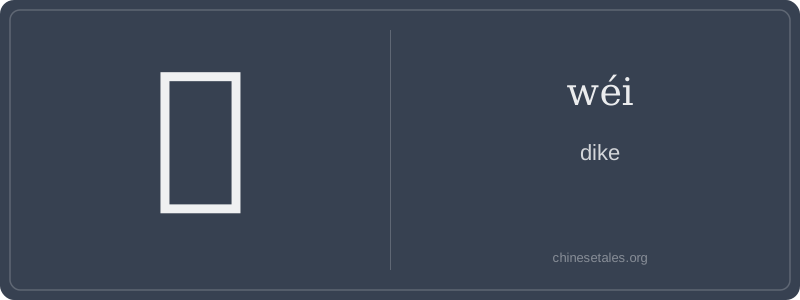
The earliest form of 圩 appears in late Han and Tang stele inscriptions — not oracle bones (it’s too young for that). Visually, it’s a brilliant stroke economy: the left radical 土 (tǔ, ‘earth’) anchors it firmly in soil and construction, while the right side 回 (huí, ‘to circle, return’) is stylized into two stacked squares — representing not literal circles, but the *enclosing, looping shape* of an earthen wall built around fields. Over centuries, 回 simplified from full square-within-square to the clean, compact 6-stroke structure we see today: two horizontal lines capped by two verticals — a minimalist diagram of a raised perimeter.
This visual logic directly shaped its meaning: 圩 doesn’t mean ‘wall’ or ‘barrier’ abstractly — it means ‘the enclosed, protected earth itself’. By the Song Dynasty, 圩田 (wéi tián, ‘enclosed-field agriculture’) was a celebrated innovation praised in texts like Shen Kuo’s *Dream Pool Essays* for transforming marshes into rice paddies. The character’s very shape — earth + enclosure — became a linguistic blueprint for resilience: not stopping water, but defining safe space *within* it.
At its heart, 圩 (wéi) isn’t just a ‘dike’ — it’s a quiet testament to human negotiation with water in southern China. Unlike the massive, imperial-scale dams of northern rivers, 圩 evokes intimate, community-built earthen embankments that ring low-lying farmland or villages in the Yangtze and Pearl River deltas. It carries a gentle, localized weight: not conquest over nature, but careful coexistence. You’ll almost never see it alone — it appears in compound nouns like 圩堤 or 圩田, rarely as a verb or standalone noun in modern speech.
Grammatically, 圩 functions exclusively as a noun, usually embedded in technical or regional terms. Learners might mistakenly try to use it like 堤 (dī, 'levee') — but 圩 is far more specific: it implies *enclosed, cultivated land protected by low earthen walls*, often in flood-prone wetlands. You wouldn’t say ‘build a 圩’; you’d say ‘repair the 圩堤’ or ‘drain the 圩田’. Its pronunciation wéi rhymes with ‘way’, reinforcing its role as a *way* to keep water at bay — a subtle but vital distinction.
Culturally, 圩 reflects centuries of agrarian ingenuity in Jiangnan and Guangdong — places where people didn’t flee floods, but engineered micro-landscapes inside them. Interestingly, many learners misread it as yú (like 鱼) due to the ‘weí’ sound’s unfamiliarity, or confuse it with 帷 (wéi, ‘curtain’) — both share pronunciation but zero semantic overlap. And yes — it *can* be read xū in rare dialectal place names (e.g., 东圩 xū), but that’s archaic and geographically hyper-specific; for all practical purposes, wéi is the only reading you need.