圢
Character Story & Explanation
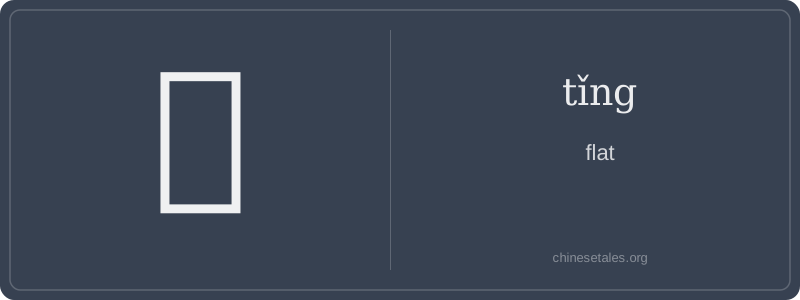
The character 圢 first appeared in late Warring States bamboo texts and early Han dynasty seals — not oracle bones — as a stylized combination of two elements: the radical 扌 (hand) on the left and 丁 (dīng, a nail or square peg) on the right. Early forms show a hand pressing down firmly on a rigid, angular shape — not a surface, but a *resistant object*. Over centuries, the hand radical simplified into 扌, while 丁 retained its sharp, blocky form, reinforcing the sense of unyielding rigidity. The modern shape preserves this tension: the left side ‘acts’, the right side ‘resists’ — no curves, no give.
This visual logic shaped its meaning: from physical immovability (‘pressing down on a fixed peg’) to metaphorical inflexibility — hence 圢直 ('rigidly upright') in classical commentaries on ritual posture, and 圢然 ('blankly stunned') in Tang poetry describing shock-induced emotional paralysis. Unlike 平 (which evokes calm equilibrium), 圢 carries the faint echo of effort — the strain of maintaining absolute straightness. Its rarity in modern speech reflects how Chinese values subtlety over extremity: true balance isn’t flat; it’s dynamic. That’s why 圢 appears mostly in literary or critical contexts — naming what happens when balance tips into sterility.
Here’s the twist: 圢 (tǐng) doesn’t mean 'flat' in the everyday sense — not like a flat pancake or a flat surface. It means *flat* as in *emotionally uninflected*, *toneless*, *monotonous*, or *lacking variation* — think of a voice that drones on without rise or fall, or a landscape so featureless it feels oppressive. In Chinese, this isn’t just descriptive; it’s evaluative and often subtly critical. A 圢 tone suggests dullness, emotional detachment, or even passive resistance — something deeply culturally resonant in a language where tonal nuance carries enormous interpersonal weight.
Grammatically, 圢 is almost always used as an adjective before nouns (e.g., 圢调 tǐng diào — 'monotone') or in fixed compounds; it rarely stands alone in speech. You won’t say 'this table is 圢' — that would sound nonsensical. Instead, you’ll hear it modifying abstract qualities: 圢直 (tǐng zhí, 'rigidly upright'), 圢板 (tǐng bǎn, 'stiff and inflexible'), or 圢然 (tǐng rán, 'suddenly blank/numb'). Notice how it often implies *excessive* straightness — not neutral flatness, but flatness that has lost vitality.
Learners frequently misread 圢 as a simple synonym for 平 (píng, 'level, flat'), leading to awkward or even offensive phrasing (e.g., saying 圢面 instead of 平面 sounds like accusing a surface of being emotionally vacant!). Also, its pronunciation tǐng is easily confused with 挺 (tǐng, 'quite, rather'), which shares the same sound but zero semantic overlap — a classic homophone trap. Native speakers rely on context and compound usage, not isolated characters, so mastering 圢 means learning its habitual pairings, not memorizing definitions.