圞
Character Story & Explanation
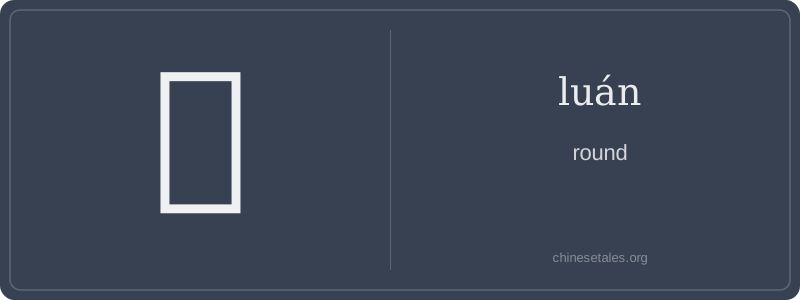
The earliest form of 圞 appears in late Warring States bronze inscriptions and Han dynasty seals — not as a pictograph of a circle, but as a stylized, tightly wound spiral enclosing a central dot, resembling a coiled serpent or a whirlpool viewed from above. Over centuries, scribes simplified the spirals into concentric curved strokes, then standardized them into the four balanced, looping arcs we see today — each arc mirroring the next, forming a closed, self-contained whole with no beginning or end. The radical is actually the outer frame itself: a rare case where the entire character *is* its own radical — the 'enclosing' structure (冂-like but fully circular) defines both form and meaning.
This visual perfection directly shaped its meaning: in classical texts like the Huainanzi, 圞 described the primordial unity before division — the undifferentiated Daoist 'One' that contains all opposites. Later, poets used it for cosmic symmetry: Lu You wrote of ‘luán yuè chuí tiān’ (the orbicular moon hanging in heaven), emphasizing not illumination but flawless, unbroken form. Its rarity today isn’t decline — it’s preservation: reserved only for moments when 'round' must carry metaphysical weight.
Think of 圞 not as a standard 'round' character like 圆 (yuán), but as the ancient, ceremonial cousin — the kind of 'round' you’d find carved into a jade bi disc or traced in calligraphy during a Daoist ritual. It conveys perfect, symmetrical, almost sacred roundness: not just shape, but wholeness, harmony, and cyclical completeness — closer to the English word 'orbicular' than 'round'. It’s poetic, literary, and nearly extinct in speech; you’ll almost never hear it in daily conversation.
Grammatically, 圞 functions only as an adjective (never a verb or noun) and appears almost exclusively in fixed literary phrases or compound words — never alone in modern sentences. Learners sometimes try to substitute it for 圆 ('circle', 'round'), but that’s like using 'orbicular' instead of 'round' in casual English: technically correct, but instantly marks you as quoting from a Tang dynasty poem. Example: 圞月 (luán yuè) means 'full, perfectly round moon' — not just any full moon, but one radiating celestial balance.
Culturally, 圞 evokes classical aesthetics — think ink-painting misty mountains circling a still pond, or the unbroken loop of the taijitu. Its near-total absence from spoken Mandarin and HSK lists makes it a 'ghost character': known to scholars, admired by calligraphers, but functionally retired from daily use. A common mistake? Assuming it’s a variant of 圆 — but they’re etymologically unrelated, and mixing them up signals deep confusion about Chinese character evolution, not just vocabulary.