圛
Character Story & Explanation
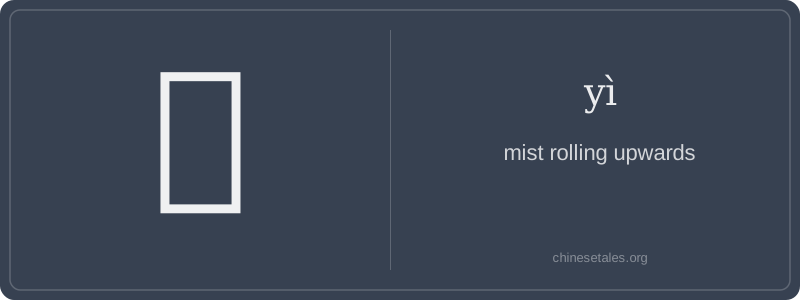
The earliest form of 圛 appears in bronze inscriptions as a highly stylized pictograph: three wavy horizontal lines stacked vertically, each slightly curved upward at the ends — like three gentle breaths rising from a still surface. Over centuries, the top and bottom waves simplified into standard ‘three-dot water’ (氵) shape, while the middle wave hardened into a straight horizontal stroke, then bent into the distinctive ‘upward curl’ seen today. Crucially, it was never built from radicals like 氵 + 易 — that’s a later folk etymology. Its original form had no ‘easy’ (易) component at all — it was pure visual onomatopoeia for rising vapour.
By the Han dynasty, 圛 was already archaic — preserved only in rhyme dictionaries and poetic glosses. The Shuōwén Jiězì (c. 100 CE) defines it as ‘qì shàng shēng yě’ (vapour ascending), citing its use in describing mist over Mount Hua. Its visual structure — three rising curves — mirrors the very phenomenon it names: no sharp angles, no downward strokes, only soft, continuous ascension. Even its pronunciation yì mimics the light, airy exhalation of breath — making 圛 one of Chinese writing’s most phonetically and graphically coherent ‘sound-and-shape icons’.
Let’s be honest — 圛 (yì) is a rare, poetic ghost of a character. It doesn’t mean ‘mist’ in the general sense (that’s 雾 wù or 霧), but specifically *mist rolling upward* — like breath rising on a cold morning, or vapour spiraling from hot spring water. That upward motion is key: it’s not static fog, but mist *in ascent*, carrying quiet energy and subtle transformation. Native speakers rarely use it outside classical poetry or highly stylized prose — think of it as the haiku syllable of Chinese characters: precise, evocative, and nearly extinct in daily speech.
Grammatically, 圛 functions almost exclusively as a noun or descriptive noun adjunct — never as a verb or standalone predicate. You’ll see it in phrases like ‘山巘巘,云巛巛,巛巛’ (a fictional classical line), but you won’t say ‘巛巛了’ or ‘巛巛起来’. Learners often mistakenly try to force it into modern sentence patterns (e.g., ‘雾巛巛地升起来’) — which sounds deeply unnatural. It’s not a verb form; it’s a frozen image, a lexical fossil.
Culturally, its rarity is part of its charm — it appears in just a handful of Tang and Song dynasty poems, usually paired with mountains, dawn, or Daoist imagery. The biggest mistake? Confusing it with 易 (yì, ‘easy’) or 意 (yì, ‘idea’) — same pronunciation, totally unrelated meaning and origin. If you encounter 圛, treat it like spotting a rare bird: pause, appreciate its elegance, and don’t try to cage it in your everyday grammar.