圕
Character Story & Explanation
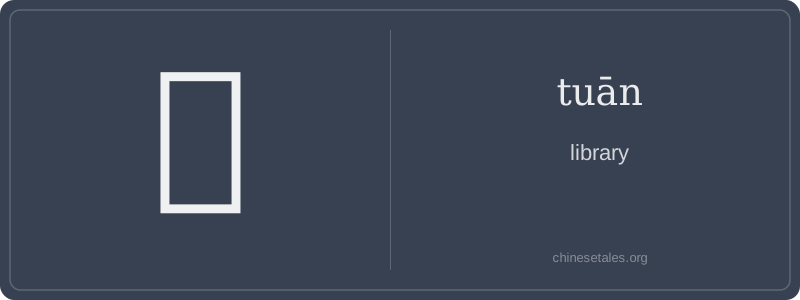
The character 圕 has no ancient origin — it doesn’t appear in oracle bone, bronze, or seal scripts. It was hand-drawn in 1924 by librarian Du Dingyou as a single-glyph abbreviation. Visually, it layers the top of 图 (tú, 'map/illustration'), the left radical of 书 (shū, 'book' — the '⺮' bamboo radical, subtly echoed in the upper-left strokes), and the right-hand component of 馆 (guǎn, 'hall' — the '官' part, mirrored and compressed into the lower-right frame). Its structure isn’t evolved — it’s engineered: a tidy square enclosing three conceptual anchors — image, text, and space — all essential to a library’s identity.
This wasn’t whimsy — it was urgent pragmatism. In pre-computer cataloging, saving two characters per entry multiplied efficiency across thousands of records. Though never adopted officially, 圕 gained quiet prestige: featured in the 1930《中华大字典》(Zhōnghuá Dà Zìdiǎn), praised by scholars like Hu Shih, and still stamped on rare book accession slips in Beijing University Library. Its visual form — a bounded, symmetrical container — mirrors the library’s role: an ordered universe holding knowledge within clear walls. No ancient sage carved it — but librarians, those unsung architects of memory, designed it with reverence.
Here’s the delightful paradox: 圕 (tuān) means 'library' — yet it’s not a traditional character at all. It’s a 20th-century typographic invention, born not from oracle bones or calligraphy, but from practical printing needs. In the 1920s, Chinese librarian and linguist Du Dingyou grew frustrated typing the three-character phrase 图书馆 (tú shū guǎn) repeatedly on library cards and catalogs. So he fused the first character of each word — 图 (tú), 书 (shū), and 馆 (guǎn) — into one compact glyph: 圕. It’s pronounced tuān, a portmanteau blend of tú and guǎn — not shū. This reveals something deeply Chinese: a cultural reverence for efficiency, elegance in simplification, and respect for institutions like libraries — even if that respect manifests as a clever shorthand.
Grammatically, 圕 functions like a noun — identical to 图书馆 — but it’s almost never used in speech or beginner writing. You’ll find it only in niche contexts: archival stamps, old library seals, academic papers on library history, or playful signage in university libraries wanting to wink at tradition. Learners should *never* use it in daily conversation — saying 'wǒ qù tuān' will confuse native speakers completely. It’s a written artifact, not a living word. Think of it like using 'Xmas' instead of 'Christmas': recognized, historically grounded, but deliberately stylized and context-bound.
Culturally, 圕 is a quiet monument to China’s modernization era — when intellectuals actively redesigned language tools to serve new social functions. Mistake alert: many learners assume it’s a simplified form or a dialect variant; it’s neither. It’s a deliberate, scholarly neologism — and its near-total absence from spoken Mandarin shows how tightly meaning and medium are bound in Chinese: some ideas live only on paper, not in breath.