圊
Character Story & Explanation
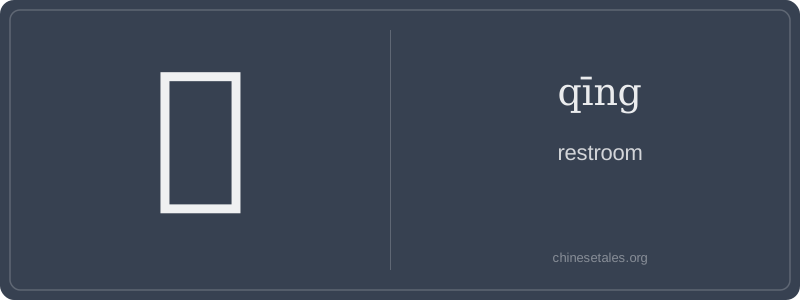
The earliest form of 圊 appears in Han-dynasty seal script — not oracle bone, as it postdates them — where it combines 囗 (wéi), a bounding square radical meaning ‘enclosure’ or ‘boundary’, with 青 (qīng), both a phonetic component and a semantic hint: 青 originally meant ‘blue-green’, but in ancient usage also carried connotations of freshness, life-force, and even purification (think of blue water in wells). Visually, the enclosure frames 青 — suggesting a *contained space where bodily renewal occurs*. Over centuries, the top of 青 simplified from 生+丹 to just 生, then further to the modern 青 shape inside the 囗 frame, solidifying into the 11-stroke structure we see today.
This character first appeared in texts like the *Qimin Yaoshu* (Essential Techniques for the Common People, 6th c. CE), an agricultural encyclopedia that treated latrines as vital infrastructure — not for hygiene alone, but for composting human waste into fertilizer. The pairing of 囗 (enclosure) and 青 (vitality/purification) thus reflects a profound ecological worldview: the 圊 wasn’t a place of disposal, but of *transformation*. Later, in Ming-Qing fiction and poetry, 圊 acquired subtle literary weight — appearing in descriptions of scholar-gardens, where a discreet, moss-covered 圊 near the bamboo grove signaled harmony between culture and nature, refinement and realism.
Think of 圊 (qīng) as the Chinese equivalent of a vintage 'Gents' or 'Ladies' sign on an ornate 19th-century European public lavatory — elegant, formal, and slightly archaic. It doesn’t mean ‘bathroom’ in the cozy, modern sense (that’s 浴室 yùshì or 卫生间 wèishēngjiān); it specifically denotes a *latrine* — a functional, often outdoor or utilitarian restroom, historically associated with outhouses, farmsteads, or classical garden architecture. Its tone (qīng, first tone) sounds like ‘cheeng’, evoking the crisp, clipped sound of a bamboo curtain swaying shut — fitting for a private yet unadorned space.
Grammatically, 圊 is almost never used alone in speech today; it appears almost exclusively in set compounds (like 圊厕 or 粪圊) or literary/historical contexts. You won’t hear someone say ‘I’m going to the 圊’ — instead, it functions like the English word ‘privy’: technically correct, understood by literate speakers, but reserved for writing, classical allusions, or humorous antiquarian flair. Learners mistakenly treat it as a casual synonym for 厕所, leading to unintentionally comical or overly solemn utterances — imagine ordering coffee and adding ‘…and also, please direct me to the 圊.’
Culturally, 圊 carries a quiet dignity: it avoids the clinical sterility of 现代卫生间 or the earthy vulgarity of 拉屎的地方. In classical texts, it appears in agricultural manuals and Confucian etiquette guides — not as something shameful, but as a necessary, orderly part of human settlement. Modern usage is mostly poetic or satirical: a writer might use 圊 to evoke rustic authenticity, or a comedian might deadpan ‘This luxury hotel has restored its original Song-dynasty 圊’ — underscoring how deeply embedded this humble character is in China’s material and linguistic history.