圉
Character Story & Explanation
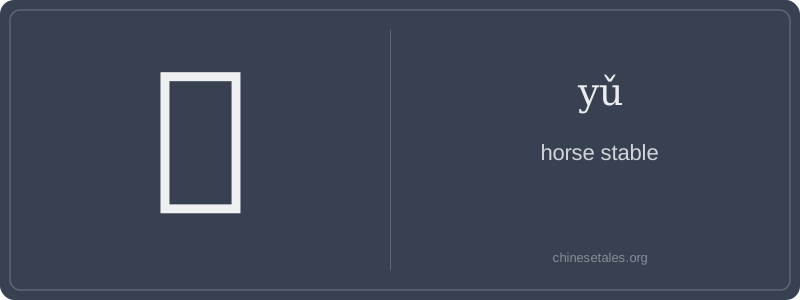
The earliest form of 圉 appears on Western Zhou bronze vessels as a pictograph showing a horse (馬) inside a square enclosure (囗). Over centuries, the horse simplified dramatically: by the Warring States period, it became the top part of 于 — a stylized abstraction of a horse’s head and neck, while the enclosing 囗 remained bold and unambiguous. The modern 11-stroke shape crystallized in clerical script: 囗 (3 strokes) frames 于 (8 strokes), with the horizontal stroke of 于 elongated to emphasize containment — like a gatebar holding the horse in place.
This visual logic directly shaped its meaning: 圭 was never about housing animals casually — it denoted state-managed stables for warhorses and tribute mounts, vital to military readiness and aristocratic prestige. In the *Zuo Zhuan*, 圉 appears in passages describing how Duke Huan of Qi ‘repaired the borders and strengthened the 圉’ — signaling not just infrastructure, but sovereignty and control over mobility itself. Even today, the character’s tight, closed shape whispers 'no exit' — a walled world where every hoofbeat was counted.
At its heart, 圉 (yǔ) is a quiet, ancient word for 'horse stable' — but don’t picture a modern barn. Think of a walled enclosure in Zhou dynasty chariot grounds: secure, bounded, and purpose-built for valuable horses. The character’s radical 囗 (wéi), meaning 'enclosure', wraps the whole concept — it’s not just *where* horses are kept, but *how* they’re protected: contained, supervised, and ritually managed. This isn’t a casual term; it carries bureaucratic weight, like 'quarantine zone' meets 'royal paddock'.
Grammatically, 圉 functions almost exclusively as a noun — never as a verb or adjective — and appears only in classical compounds or formal historical contexts. You won’t hear it in daily speech ('stable' is usually 马厩 mǎjiù or 马棚 mǎpéng), but you *will* see it in terms like 畜圉 (xù yǔ, 'livestock enclosures') or place names tied to ancient horse administration. Learners sometimes misread it as yù (like 域) or overgeneralize it as 'any kind of enclosure' — but 圉 is *specifically equine*, and always implies official, walled containment.
Culturally, 圭 (guī) and 羽 (yǔ) are phonetic red herrings — 圉’s pronunciation yǔ comes from an old rhyme group, not its components. Its rarity today makes it a 'linguistic fossil': preserved in bronze inscriptions and the *Zuo Zhuan*, where it appears in records of horse census and border defense logistics. Mistake it for 羽 (feather) or 語 (speech), and you’ll conjure absurd images — a 'feather stable' or 'speech stable' — so pay attention to that enclosing 囗 and the inner 于!