圄
Character Story & Explanation
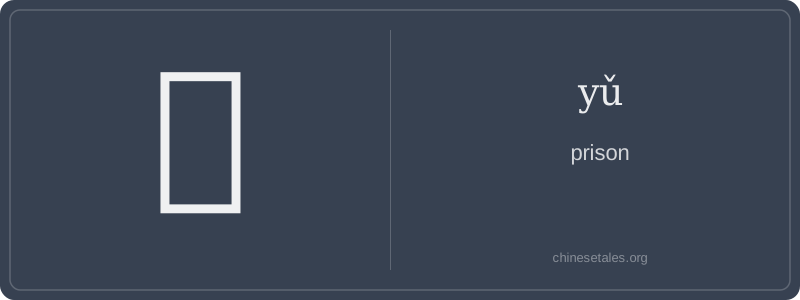
The earliest form of 圄 appears in bronze inscriptions as a simple square (囗) enclosing two parallel horizontal strokes — representing wooden bars or beams inside a walled compound. Over time, those strokes evolved into the top component 亐 (a rare variant of 于), which originally looked like crossed sticks or tied reeds — suggesting binding or confinement. By the seal script era, the shape solidified: 囗 (enclosure) + 亐 (bound/controlled element), visually shouting 'a place where movement stops'. The ten strokes aren’t random — they’re an architectural blueprint: four for the outer wall, six for internal structure and constraint.
In classical usage, 圄 appeared in texts like the *Zuo Zhuan*, describing feudal punishments where offenders were held not just physically, but symbolically — cut off from ritual participation and ancestral rites. Its meaning never broadened; unlike 监狱, it never absorbed bureaucratic or modern penal connotations. Instead, it fossilized as a literary marker of moral gravity — so much so that today, it survives almost solely in the compound 囹圄 (líng yǔ), where 圄 retains its ancient echo while 囹 adds the sense of 'cage'. The character’s visual stillness — that tight, unbroken 囗 — mirrors its semantic stillness: no evolution, no slang, just enduring, silent walls.
At first glance, 圄 (yǔ) feels like a quiet, ancient word — and it is. It means 'prison', but not the modern kind with steel bars and surveillance cameras. Think of it as the *classical* prison: a walled enclosure for holding people, steeped in ritual gravity and literary weight. In modern Chinese, you’ll almost never hear it in daily speech — no one says 'I’m going to 圄' — but it appears powerfully in idioms, historical texts, and formal writing, always evoking solemnity, injustice, or moral consequence.
Grammatically, 圄 functions almost exclusively as a noun, often in fixed compounds (like 牢圄 or 囹圄). You won’t find it in verb phrases or casual modifiers — it’s too heavy for that. Learners sometimes try to use it like 监狱 (jiānyù), but that’s like swapping 'dungeon' for 'jail' in English: same general idea, wildly different register and resonance. Also, note its radical: 囗 (wéi), the 'enclosure' radical — the same one found in 国 (country), 囚 (prisoner), and 囚 (to imprison). That ring isn’t decorative; it’s architectural logic — walls defining space, control, and boundary.
Culturally, 圄 carries Confucian and Legalist undertones: imprisonment wasn’t just punishment, but social correction — a temporary removal from the harmonious order. Mistake it for a generic synonym of 'prison', and you’ll sound oddly archaic or even poetic (in the wrong context!). And watch out: its pronunciation yǔ rhymes with 'you', but don’t let that mislead you — this character has zero connection to pronouns or politeness. It’s all about containment, silence, and stone walls.