圃
Character Story & Explanation
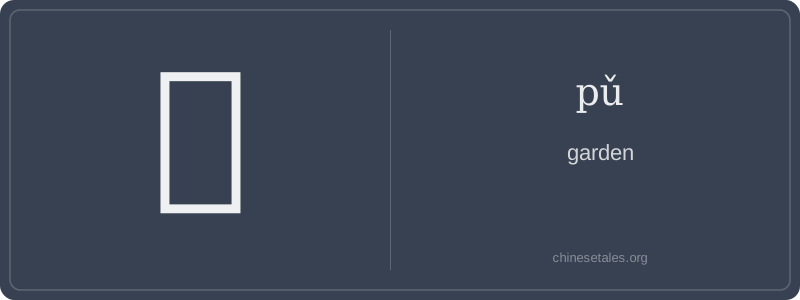
The earliest form of 圃 appears in bronze inscriptions as a square enclosure (囗) containing two parallel horizontal lines — representing neatly tilled rows of crops or plants. That simple box-with-lines evolved into the modern character: the outer 囗 (wéi, 'enclosure') remains unchanged, while the inner part simplified from 口 + 十 (a mouth-like shape plus cross-stroke) to 甫 (fǔ), which originally depicted a man kneeling beside a growing plant — later phoneticized but retaining the sense of 'cultivated ground'. By the Han dynasty, the structure was standardized as 囗 + 甫, with 甫 providing both sound and semantic reinforcement: 'what is properly planted and tended.'
By the Warring States period, 圃 appeared in texts like the *Zuo Zhuan* describing aristocratic estates with designated plots for medicinal herbs and rare trees. In the *Analects*, Confucius compares moral cultivation to tending a 圃 — careful, bounded, seasonal work. The visual logic is elegant: the 囗 doesn’t imprison nature; it defines the space where nurture becomes possible. Even today, when you see 圃 in a botanical institution’s name, you’re glimpsing a 2,500-year-old idea: that wisdom grows best within thoughtful limits.
Think of 圃 (pǔ) not as a generic 'garden' like the English word, but as a *walled, purposeful plot* — historically, a cultivated enclosure for herbs, medicinal plants, or ornamental shrubs. It’s more precise and old-fashioned than 花园 (huāyuán) or 公园 (gōngyuán); it carries the quiet dignity of a scholar’s courtyard garden or a Daoist herbalist’s plot. You’ll rarely hear it in casual speech — it’s literary, poetic, or institutional (e.g., in school names like 'botanical garden').
Grammatically, 圃 functions almost exclusively as a noun, often in compound words or formal titles. It doesn’t take aspect particles (了, 过) or modifiers like 很 — you wouldn’t say '很圃'! Instead, it appears after descriptive nouns: 药圃 (yào pǔ, 'herb garden'), 苗圃 (miáo pǔ, 'nursery'). In classical texts, it sometimes appears with the verb 有 ('has') or as part of a place name — never as a verb or adjective.
Culturally, 圃 evokes harmony between human intention and natural growth: the 囗 radical isn’t just 'enclosure' — it’s *deliberate containment*, reflecting ancient Chinese agricultural philosophy where boundaries enable flourishing. Learners often misread it as 'pu' (like 普) or confuse it with 埔 (bù, 'harbor'), but 圃 is always pǔ, always about cultivated land — never water, not urban, not abstract. Its rarity in daily speech makes it a subtle marker of literary fluency.