圂
Character Story & Explanation
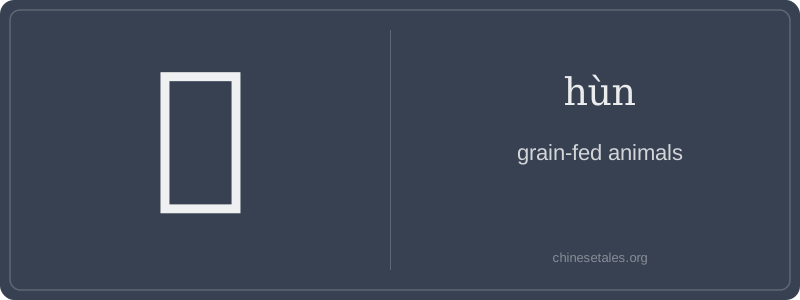
Oracle bone inscriptions show 圂 as a simple square (囗) enclosing a stylized grain plant (禾) — unmistakably depicting a walled plot where millet grew *and* animals grazed or were fed. Over centuries, the square became more angular (evolving into the modern 囗 radical), while 禾 retained its bent-stalk-and-grains form. By the Warring States period, bronze script standardized the 10-stroke layout we use today: the enclosure drawn first, then the grain inside — no strokes crossing the boundary, reinforcing the idea of controlled, intentional feeding within defined space.
This wasn’t just a barnyard sketch — it encoded an economic shift. Early texts like the *Book of Rites* (Lǐjì) distinguish 圂 animals from wild or pasture-raised ones, linking them to ritual offerings and household wealth. The character appears in Han dynasty tax records listing ‘hùn shǐ heads’ alongside grain yields, showing how tightly animal value was tied to cereal production. Even today, in rural Sichuan or Shaanxi, elders may refer to ‘hùn pigs’ when describing heritage breeds raised exclusively on fermented rice bran — preserving the original semantic core across 2,500 years.
Let’s unpack 圂 (hùn) like a linguist archaeologist: it’s not about ‘pigs’ or ‘livestock’ in the generic sense — it specifically means ‘grain-fed animals’, especially pigs raised on cultivated grain (not foraged). The radical 囗 (wéi) is a ‘boundary’ or ‘enclosure’ — think of it as a pen or corral. Inside? 禾 (hé), meaning ‘grain’ or ‘millet’, the staple crop of ancient China. So visually and semantically, 圂 = ‘enclosed grain’ → ‘animals kept inside to eat grain’. It’s an agricultural term with deep roots in pre-imperial farming practice.
Grammatically, 圂 functions almost exclusively as a noun — rarely used alone today, but vital in classical texts and compound words. You won’t say ‘I saw a 圂’; instead, you’ll encounter it in terms like 圂豕 (hùn shǐ, ‘grain-fed pigs’) or 圂肥 (hùn féi, ‘manure from penned livestock’). Learners often misread it as ‘pigsty’ (which is actually 猪圈, zhū juàn) — but 圂 isn’t the structure itself; it’s the *concept* of grain-raised animals as a category. That subtle distinction matters in historical or agrarian contexts.
Culturally, 圂 reflects how early Chinese society linked animal husbandry with grain surplus and land management. Its absence from HSK isn’t because it’s obsolete — it’s still used in agricultural policy documents, veterinary journals, and regional farming manuals — but because it’s hyper-specific. A common mistake is confusing it with 混 (hùn, ‘to mix’), which sounds identical but shares no semantic ground. Pronunciation alone won’t save you here — you need the enclosure + grain logic.