囿
Character Story & Explanation
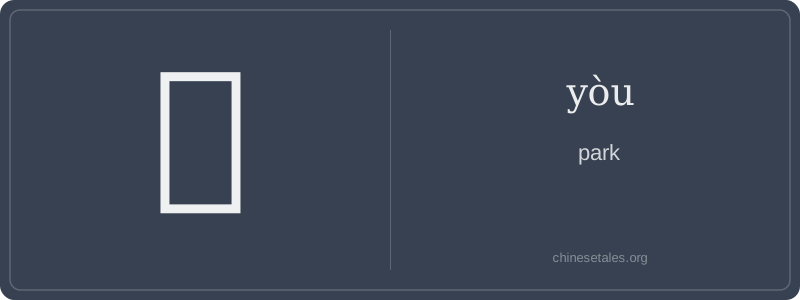
The earliest form of 囿 appears in Western Zhou bronze inscriptions as a square enclosure (the 囗 radical) containing two simplified pictographs resembling deer (鹿) — not because it was *only* for deer, but because deer were iconic game animals symbolizing abundance and grace within the royal preserve. Over centuries, the deer evolved into the 又 component (originally a hand-like shape, later stylized), while the enclosing 囗 remained powerfully literal — a wall, a boundary, a deliberate act of separation from the wild beyond. By the Qin-Han period, the character had stabilized into its current nine-stroke form: 囗 (enclosure) + 又 (hand/agent), visually encoding the idea of *humanly imposed containment*.
This visual logic shaped its meaning trajectory: from Bronze Age hunting ground → Warring States philosophical metaphor (e.g., Mencius uses 囿 to illustrate benevolent rule — ‘a ruler who opens his 囿 to the people shows virtue’) → Tang-Song poetic trope for cultivated natural beauty. In the *Classic of Poetry*, ‘王在灵囿,麀鹿攸伏’ (The King is in the Sacred Enclosure; does rest quietly) reveals how 囿 embodied both political authority and tranquil order — a space where nature submitted gracefully to human presence, not through conquest, but through harmonious design.
Think of 囿 (yòu) as China’s ancient version of a walled botanical garden or royal game reserve — not your modern city park with benches and joggers, but a meticulously controlled, enclosed space for imperial leisure, hunting, and ritual observation of nature. Unlike 公园 (gōngyuán), the generic 'public park,' 囿 carries weighty historical resonance: it implies enclosure, privilege, and intentionality — like calling Central Park 'The Royal Enclosure' in 18th-century London. It’s rarely used in daily speech today; you’ll encounter it mostly in classical texts, historical documentaries, or poetic descriptions of classical gardens.
Grammatically, 囿 functions almost exclusively as a noun — never a verb or adjective — and almost never appears without modifiers: you won’t say *‘wǒ qù yòu’* (I go to the park) alone; instead, it appears in compounds like 灵囿 (Língyòu, ‘Sacred Enclosure’) or as part of place names (e.g., 周文王囿). Learners often mistakenly treat it like 公园 and try to use it independently — a subtle but telling error that instantly flags non-native usage. Also, note its tone: yòu (fourth tone), not yóu (second tone, like ‘to wander’).
Culturally, 囿 reflects the ancient Chinese worldview where harmony with nature wasn’t about open access, but about curated containment — a microcosm under human stewardship. Modern writers sometimes revive 囿 ironically or elegantly to evoke timelessness: ‘这座小院仿佛一座现代囿’ (This courtyard feels like a modern 囿). But beware: using it casually sounds either archaic or pretentious — like describing your backyard BBQ as ‘a symposium in the Agora.’