囷
Character Story & Explanation
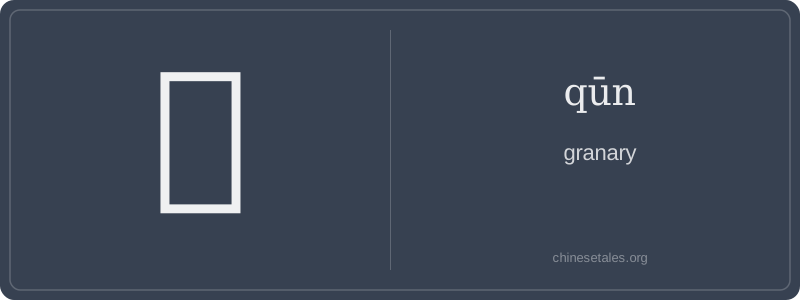
The earliest form of 囷, found on Shang dynasty oracle bones, was a vivid circle enclosing stacked grains — a literal pictograph of a round, walled granary viewed from above. Over centuries, the outer circle simplified into the square-like enclosure 囗 (a stylized boundary wall), while the inner element evolved: bronze script showed grain stalks or bundles inside; by the Small Seal Script era, scribes replaced those stalks with 君 — not for meaning, but because its pronunciation matched the local dialect term for granary. That phonetic substitution stuck, turning a clear picture into a phonosemantic hybrid.
This visual shift mirrors China’s agricultural centralization: early granaries were family-scale, but by the Warring States period, 囷 appeared in texts like the *Zuo Zhuan*, describing state-controlled reserves used to stabilize grain prices and reward loyal ministers. Its round shape wasn’t arbitrary — circular granaries allowed even airflow and minimized corners where pests could hide. Even today, archaeologists identify Han dynasty granary ruins by their distinctive circular foundations — the very shape encoded in 囷’s strokes.
At its heart, 囷 (qūn) is a quiet but potent symbol of ancient Chinese agrarian life — not just 'a granary,' but specifically a *circular, walled grain store*, often built above ground with thick earthen walls for ventilation and pest control. The character’s enclosure radical 囗 (wéi, 'to surround') isn’t decorative: it literally frames the stored abundance inside, while the inner component 君 (jūn, 'ruler' or 'lord') isn’t about authority here — it’s a *phonetic clue* (both 囷 and 君 share the -ūn rhyme in Old Chinese), though later generations couldn’t help reading hierarchy into it: grain was wealth, and controlling grain meant controlling people.
Grammatically, 囷 is almost exclusively literary or historical — you won’t hear it in daily speech ('cāng' or 'liángcāng' are used instead). It appears mostly as a noun in classical texts, compound words, or poetic descriptions. For example, in the phrase ‘囷仓’ (qūn cāng), it pairs with another granary word to mean 'grain stores' collectively — think of it like saying 'barn-and-silo' in English: redundant but emphatic. Learners rarely misuse it *in speech* (since it’s absent from HSK), but when writing essays on ancient economy, they might wrongly substitute it for simpler terms like 仓 — missing the precise architectural and cultural connotation of circular, elevated storage.
Culturally, 囷 evokes the Confucian ideal of prudent stewardship: storing surplus grain wasn’t hoarding — it was moral duty, ensuring famine relief and social stability. Mistaking it for a generic 'warehouse' misses this ethical weight. Also, note its rarity: even native speakers may pause at 囷 — it’s a character that lives in bamboo slips and bronze inscriptions, not WeChat messages.